AI accelerates the work. Decision integrity is what survives the deal.
A practical map of the AI stack — and the layer that has to outlive every tool in it.
Most AI tools for private equity are workflow accelerators: document Q&A, memo drafting, sourcing intelligence, portfolio analytics. They each shorten one step. None of them defends the IC decision two years later when the LP asks why.
Private equity teams evaluating AI tools are usually comparing several different categories at once:
- document reasoning and Q&A across a deal pack
- sourcing intelligence and target discovery
- analyst copilots and modeling acceleration
- portfolio analytics and reporting
- diligence platforms and data room AI
- the decision integrity layer — the system that owns the IC memo, the risk signals, and the post-close drift
The right tool depends on which layer of the workflow needs help. Most layers have multiple solid options. The decision integrity layer has been missing.
Why most “best AI tools” roundups miss the real distinction
They rank tools side by side on capability headlines without asking the harder question: which tool produces output that survives the room? Most do not. AI summaries get faster, prettier, and more confident — but they remain unstructured artifacts on a shared drive that nobody opens after Q+1.
That is the real selection problem. Speed without survivability is faster confusion.
Four questions that actually matter
- Does the tool produce output that can be defended at IC against firm policy — or just summarized?
- Does every figure in the output trace back to the source cell, or is it LLM-generated narrative?
- Does the system lock the decision basis at IC approval, or does it forget once the deal closes?
- When an operator update lands six months later, does the system tell you whether the original thesis still holds?
Where Capital Refinery sits
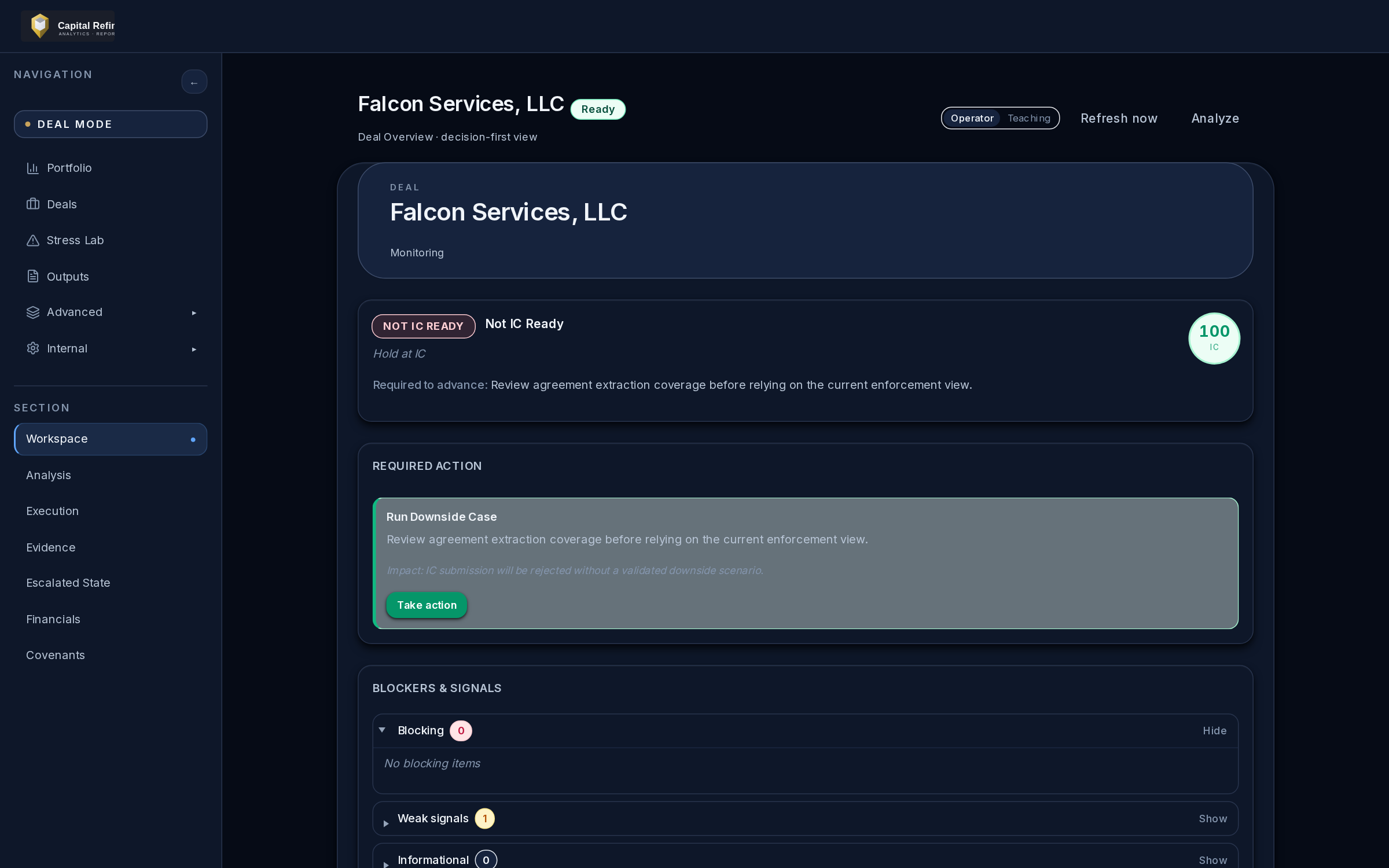
Capital Refinery is not in the same category as document Q&A, sourcing, or analyst copilots. It is the decision integrity layer that takes the output of those tools and turns it into a graded IC record that survives the deal: lane-aware IC memo, Risk Signals scoreboard, source-backed numbers, IC anchor on approval, drift tracking after the room votes, and provenance-signed exports for LP and audit.
The IC memo, graded against firm policy.
Drop the source pack. Get back risk signals with observed value, firm threshold, and verdict. Click any figure and trace it to the source cell.
Which layer does each tool cover?
| Capability | Tool · Focus | Capital Refinery |
|---|---|---|
| Hebbia | Document reasoning and research workflows | Adjacent — feeds into the deal pack ingest |
| BlueFlame | Analyst workflow copilots and memo drafting | Adjacent — accelerator, not a decision record |
| Grata | Sourcing intelligence and discovery | Upstream — finds the deal |
| Allvue | Fund operations and capital admin | Downstream — books the deal |
| Juniper Square | LP relations and capital ops | Downstream — reports on the deal |
| 73 Strings | Portfolio analytics and valuations | Adjacent — surface metric layer |
| Datasite / data-room AI | Diligence file search and summary | Adjacent — feeds into the source pack |
| Capital Refinery | — | The decision integrity layer — IC memo, Risk Signals, drift tracking, signed exports |
Already running tools in some of these categories?
The natural next question is what owns the IC decision once the accelerator output lands. Bring us a deal pack you would put in front of IC. Same-day diagnostic pack back, source-backed.