Know when the covenant cushion is real.
The ratio is not the hard part. The definition is.
Headline leverage covenants get reported with a comfortable cushion. The cushion lives inside an EBITDA definition that has been negotiated to sit above the actual operating result. Capital Refinery surfaces the composition, the drift, and the moment the cushion stops being real — before the lender call lands on the partner who signed the position.
The headline ratio is the report. The definition is the risk.
Read any private-credit covenant compliance certificate. Leverage at 4.78x against a 6.0x covenant. 25% cushion. Looks healthy. Now read the EBITDA definition behind it. Add-backs for restructuring, transaction expenses, “extraordinary and non-recurring” losses that have recurred for three consecutive quarters. Pro-forma adjustments for synergies that haven't closed. PIK interest counted as paid.
The cushion is real until the definitions move. And the definitions are moving — through amend-and-extend negotiations, through cash-to-PIK conversions, through add-back lists that get longer rather than shorter. The covenant test is being preserved by changing what counts.
The borrower is not breaching the covenant. The cushion is being engineered around the breach.
Reported cushion, real cushion, same quarter.
The covenant test is preserved by changing what counts. The dashed line is the covenant; the real result has been walking toward it while the reported cushion held flat.
Covenant erosion is now documented at the lender, law firm, and rating-agency level.
- Sidley Austin2026-03-24
Financial Covenants in Private Credit Transactions
A typical leverage covenant in a direct lending transaction may be set with a 25–35% cushion to the EBITDA projected in a sponsor or borrower model. Common add-backs that are more highly negotiated include restructuring and integration costs; transaction expenses; extraordinary, unusual, or nonrecurring losses.
Why it mattersTop-tier lender counsel confirms the cushion is engineered around a negotiated EBITDA. The 25–35% headroom is documentation, not protection.
Read source → - Proskauer Rose · Private Credit Group2025-09-16
Private Credit Deep Dives — Dodgy accounting or financial covenant breach?
There has been a notable rise in instances where private credit funds question or dispute the quarterly and monthly financials provided by borrowers — including borrowers and sponsors seeking to maximise the use of add-backs in loan agreements to inflate EBITDA figures and thereby maintain covenant compliance.
Why it mattersAdd-back disputes have become a recurring live event between funds and borrowers. The wedge is operational, not theoretical.
Read source → - Moody's Ratings · via Alternative Credit Investor2025-11-17
Moody's: Rising complexity in private credit could amplify risks
The erosion of covenant protection is credit-negative for lenders, and the overall opacity of the market means weaker early-warning indicators and potentially lower recoveries in distress scenarios.
Why it mattersRating-agency framing of covenant erosion as a measurable credit-quality issue. Not a documentation curiosity — a recovery problem.
Read source → - Lincoln International2025-11-01
Q3 2025 Lincoln Senior Debt Index
Covenant defaults declined quarter-over-quarter, going from 3.4% to 3.2%, but have increased by 1.0% year-over-year. 11% of Lincoln-valued loans paid PIK in 2025; Q4 amendment activity rose 13% QoQ with covenant-holiday activity up 14%.
Why it mattersThe canonical private-credit covenant tracker shows the system absorbing stress through amendments, holidays, and PIK conversions — not through visible breaches. The cushion is being re-engineered, not held.
Read source → - Octus · BDC Weekly Roundup2026-04-23
Private Credit's Cash-to-PIK Shift; Medallia Nears Debt-for-Equity Swap
Octus identified 27 borrowers that switched a portion or all of the interest paid to lenders to PIK in the fourth quarter of 2025 after paying all-cash interest in the third quarter. Borrowers paying interest in kind could be an early indication of stress.
Why it mattersBDC-disclosure-derived count of named cash-to-PIK conversions in a single quarter. Covenant compliance preserved by changing how cash is defined, not by improving performance.
Read source → - Lincoln International · via LevFin Insights2024-06-26
Devil in the Default Details — Amendments and LMEs Mask Private Credit Default Rate
Sponsors, borrowers and lenders are getting ahead of defaults and are solving for the default through an increase in amendment activity. As long as you solve for liquidity issues through a small equity injection to get to the other side, lenders will be favorably inclined to amend.
Why it mattersNames the central mechanism: covenant breaches don't get reported, they get amended. The headline default rate and the actual stress have decoupled.
Read source → - Goodwin Procter2024-08-12
Pluralsight Change of Control Transaction — The Tip of the Private Credit Iceberg?
EBITDA adjustments can be too complex or stretched for rating agencies' comfort level, which is inhibitive to a syndicated solution. The original Pluralsight loan was structured against revenue growth rather than cash flows or earnings — a definitional choice that ultimately drove a multi-billion-dollar write-off across Vista and its co-investors when the metric stopped working.— paraphrase
Why it mattersThe named-borrower exhibit. A specific deal where the definition of the underlying covenant metric — not a missed ratio — is the proximate cause of a multi-billion-dollar lender outcome.
Read source →
Three places the headline ratio looks fine and the cushion is gone.
- 01 · The recurring add-back
“Permitted under §1.01.”
An add-back labeled extraordinary in Q1 reappears in Q2, Q3, Q4. The credit agreement permits it. The audit committee notices. The cushion you sold is 23 basis points narrower than the certificate said.
- 02 · The cash-to-PIK conversion
Interest paid as additional principal.
The cash interest line goes to zero. The principal balance grows. The leverage ratio holds because EBITDA is computed pre-interest. The lender holds a paper return; the borrower holds compounding debt. The cushion looks identical and is materially worse.
- 03 · The amend-and-extend
The covenant moved before the breach.
A small equity injection from the sponsor unlocks an amendment that resets the covenant level and adds two quarters of holiday. The default rate stays at 3.2%. The position is structurally weaker. The next quarter's certificate looks pristine. And six months later, when the borrower can't perform, the question lands on the deal partner who signed off on the amendment — not the lawyer who drafted it.
The cushion, decomposed.
Capital Refinery does not replace your covenant compliance workflow. It surfaces the composition behind the ratio so the team knows whether the cushion is real before the borrower's next certificate lands.
- ▸Credit agreement projector — extracts the EBITDA definition, baskets, sweep mechanics, and amendment history into structured form, with section-level citations back to the agreement
- ▸Add-back composition over time — every add-back tagged by category, recurrence pattern flagged, definitions mapped to the originating clause
- ▸Cash-to-PIK detection — interest line composition surfaced quarter-over-quarter, with named conversion events rendered as risk signals
- ▸Amend-and-extend lineage — every amendment captured with its reset, holiday, and consideration details; deviations from the original covenant package made explicit
- ▸Synthetic cushion — the leverage ratio recomputed with adjusted EBITDA stripped of the most-negotiated add-backs, surfaced alongside the headline ratio
- ▸IC anchor + drift — the covenant package the team approved at IC, with every subsequent change rendered as “since IC” movement
The ratio, the threshold, and the room that’s left.
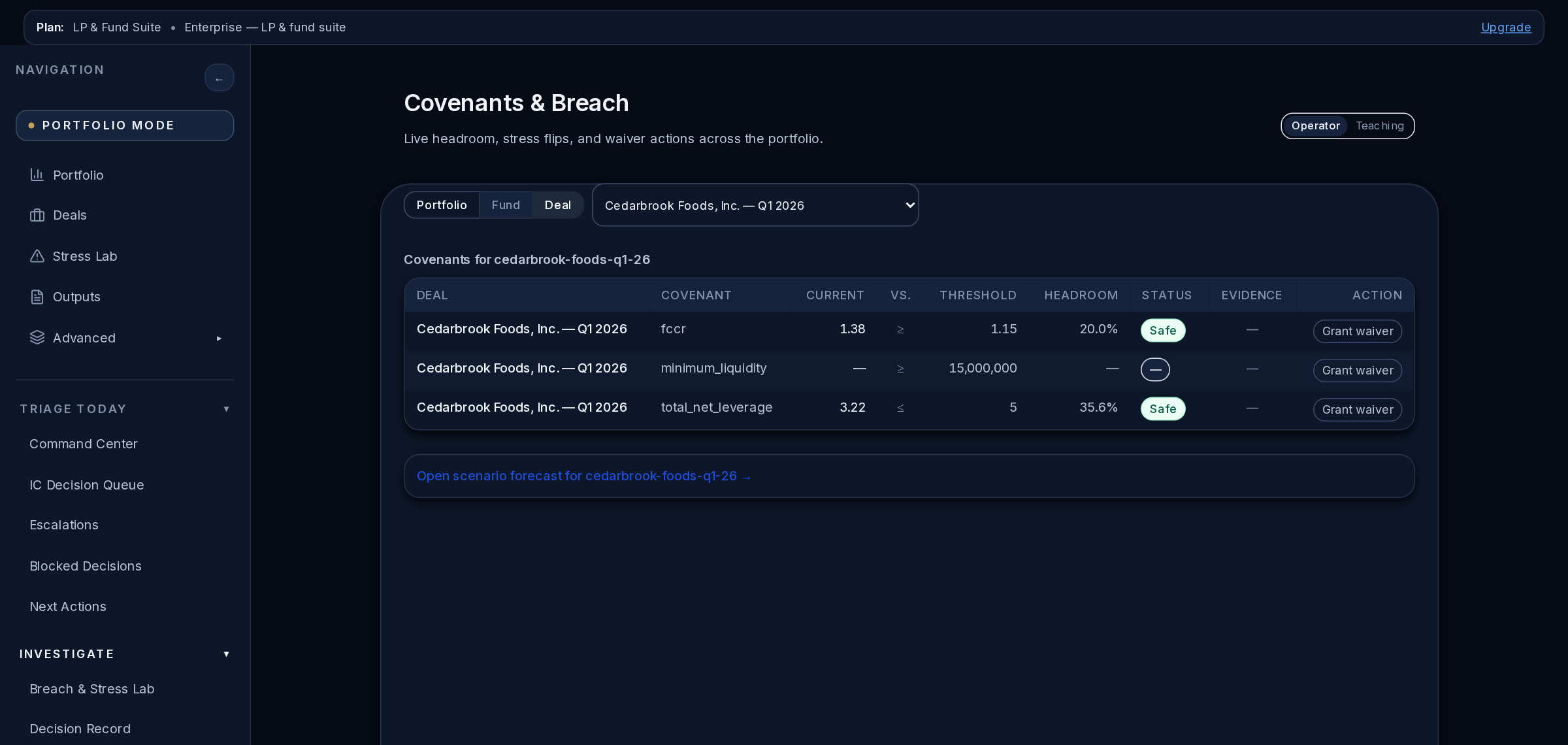
Synthetic cushion tells you whether the headline ratio is real. Covenant headroom tells you how much room is left before the test fails — and Capital Refinery reads it straight from the borrower’s compliance certificate, not a re-keyed spreadsheet. The total net leverage ratio and the fixed charge coverage ratio (FCCR) are lifted from the certificate with the cap or floor each is measured against, and the headroom is computed against the contractual threshold the lender actually signed.
On a live distribution credit: leverage 3.22x against a 5.00x cap — 1.78x of headroom; FCCR 1.38x against a 1.15x floor — 0.23x of headroom. A modeller’s forecast column cannot stand in for the certified actual, and a covenant whose actual can’t be sourced is shown blank rather than filled with an estimate.
Two different numbers, and we keep them that way — labeled and sourced. The covenant ratio (net of cash, on the negotiated EBITDA definition) flatters the picture; the analytic gross ratio is the one an underwriter actually believes. A generous covenant definition never quietly stands in for the real leverage.
Pressure-test one credit agreement.
Send one credit agreement and the last four compliance certificates. We’ll return the add-back composition, the cash-to-PIK trend, the amendment lineage, and the synthetic cushion — so the deal partner has the answer before the next call.