Before the refinance call.
Maturity is not a surprise. Forgetting it is.
The 2028 and 2029 private-credit walls are documented today. The operating conversation that determines whether the refi closes — covenant posture, performance trend, sponsor support, lender appetite — starts too late at most firms. The partner whose name is on the position is the one who fields the call when it does.

The wall is years out. The conversation is months late.
Every private-credit team can name the maturity profile of their book. The dates are in the model. They have been in the model since the deal closed. What is not in the model is the operating conversation: what has to be true twelve months before the refi for the takeout to actually clear.
That conversation tends to start six months before maturity, when the lender starts asking. By that point, the operating changes that would have positioned the borrower for a clean refinance — covenant cleanup, EBITDA recompositioning, sponsor injection, capex moderation — are no longer available on the timeline that matters. The wall did not move. The clock did.
Refi risk is not surprise risk. It is the risk that the deal partner noticed too late to do anything about it.
The 2028 wall is no longer a deferred concern.
- Reuters · via Investing.com2026-05-01
For private credit borrowers, big maturity walls are further out
Only about $15 billion of a total $84 billion of [BDC] assets mature this year, with the bulk of loan maturities peaking in 2028 and 2029.
Why it mattersEstablishes the central wedge fact. The wall is years out, which is exactly why the operating conversation gets deferred until the call lands.
Read source → - Bloomberg2026-04-22
Private Credit BDCs Face 2028 Maturity Risk, Moody's Warns on Refinancing
Moody's Ratings warns that private credit funds with outsized exposure to software and tech loans face rising refinancing and credit risks as a wave of debt maturities arrives starting in 2028.— paraphrase
Why it mattersRating-agency endorsement of the 2028 inflection. Converts the wedge from operator anxiety to underwritten risk.
Read source → - PitchBook · 2026 US Distressed Credit Outlook2025-12-01
2026 US Distressed Credit Outlook: Bifurcation, maturity wall promise busy year
About $580B of loans in the Morningstar LSTA US Leveraged Loan Index mature 2027–2029. In the US, issuers rated B− or below account for roughly 68% of 2028 and 60% of 2029 leveraged loan maturities.— paraphrase
Why it mattersThe credit-quality concentration line. The weakest borrowers are stacked into the wall — so the operating conversation cannot start at T-90.
Read source → - PitchBook LCD2025-08-01
Leveraged loan amendment activity rises in July as 2026 maturity wall eases
In 2024, companies extended $52.7B of 2026 debt, $39.2B of 2027, and $19.7B of 2025. Through 2025, borrowers had extended $20.5B due in 2026, $21.5B due in 2027, and $7.7B due in 2028.— paraphrase
Why it mattersQuantifies extend-and-pretend at scale. The conversation is happening — late, reactively, and at the cost of structure.
Read source → - Private Debt Investor2026-02-05
The five key themes of 2026: why a maturity wall really is now looming
PDI's 2026 themes piece argues the maturity wall is no longer a deferred concern but an active 2026 theme for private debt — moving from watch list to operating reality.— paraphrase
Why it mattersTrade-press recognition that the wall has crossed from "watch list" to "operating reality." Validates the page's timing.
Read source → - A&O Shearman · Global Restructuring Outlook2026-02-05
U.S. restructuring 2025 review and 2026 outlook
On First Brands' failed $6.2B Jefferies-led refinancing that preceded its September 2025 Chapter 11: allegations of financial fraud quickly emerged with the ABL and term-loan lenders and SPV lenders asserting interests in the same collateral (i.e. it appears to have been double pledged).
Why it mattersNamed case. The refi call exposed structural problems no one was tracking. Concrete proof that "found out at the refinance" is a real failure mode.
Read source → - PitchBook LCD2025-10-01
First Brands Ch. 11 tarnishes private credit with broad brush amid retail push
First Brands sought $6.2B in a global refinancing in summer 2025; potential lenders, confronted with complex capital structure, limited unencumbered assets, and emerging concerns about factoring arrangements, declined to participate. Jefferies disclosed $715M of exposure via Point Bonita Capital.— paraphrase
Why it mattersNamed lender writedown driven directly by failed refinance. Shows the cost lands on credit funds, not just the borrower.
Read source →
Eighteen months out. Twelve. Six. Three. The call.
Refi readiness is a calendar discipline, not a Q4 scramble. The conversations that determine whether the takeout closes cleanly or requires an amend-and-extend at worse terms have to start in a specific sequence.
- T − 18 months
The covenant package the team will present.
What does the EBITDA composition look like? Which add-backs are recurring? Is the cushion real or engineered? The decisions that clean up the cushion have to happen now to be defensible by T − 6.
- T − 12 months
The operating story the lender will underwrite.
Has the underwrite held? Which assumptions have moved? What does the LTM look like vs. the year of the original underwrite? The lender will reconstruct this during diligence. It is faster if it has already been reconstructed.
- T − 6 months
The sponsor support story.
Equity injection? PIK conversion? Pari ranking? The options here are determined by what the borrower's position can sustain — which depends on what was true at T − 18.
- T − 0
The call.
At this point the work is execution, not strategy. The firms that are ready close cleanly. The firms that started the conversation at T − 6 amend, extend, or restructure.
The refi clock, surfaced as a dashboard.
Capital Refinery does not negotiate the refi. It surfaces the operating conditions that determine whether the refi clears, on the calendar that matters.
- ▸Maturity ladder per position — every facility, every tranche, every PIK schedule, plotted against the operating cycle that has to be ready
- ▸Covenant cushion trend — leverage, fixed-charge, interest coverage, decomposed monthly with add-back recurrence flagged
- ▸LTM vs. underwrite — current-year operating performance plotted against the IC underwrite, with named drift and source-document trail
- ▸Refi-readiness scorecard — covenant posture, performance trend, sponsor capacity, market-window proxy, ranked by deal
- ▸T − N alerts — automatic flagging when a position crosses the 18, 12, and 6-month thresholds without the operating conversation having started
- ▸Decision timeline — every refi-relevant decision (waiver, holiday, sponsor injection, amendment) anchored with cause, evidence, and the snapshot it changed
The cushion that decides the refi timing — sourced, not re-keyed.
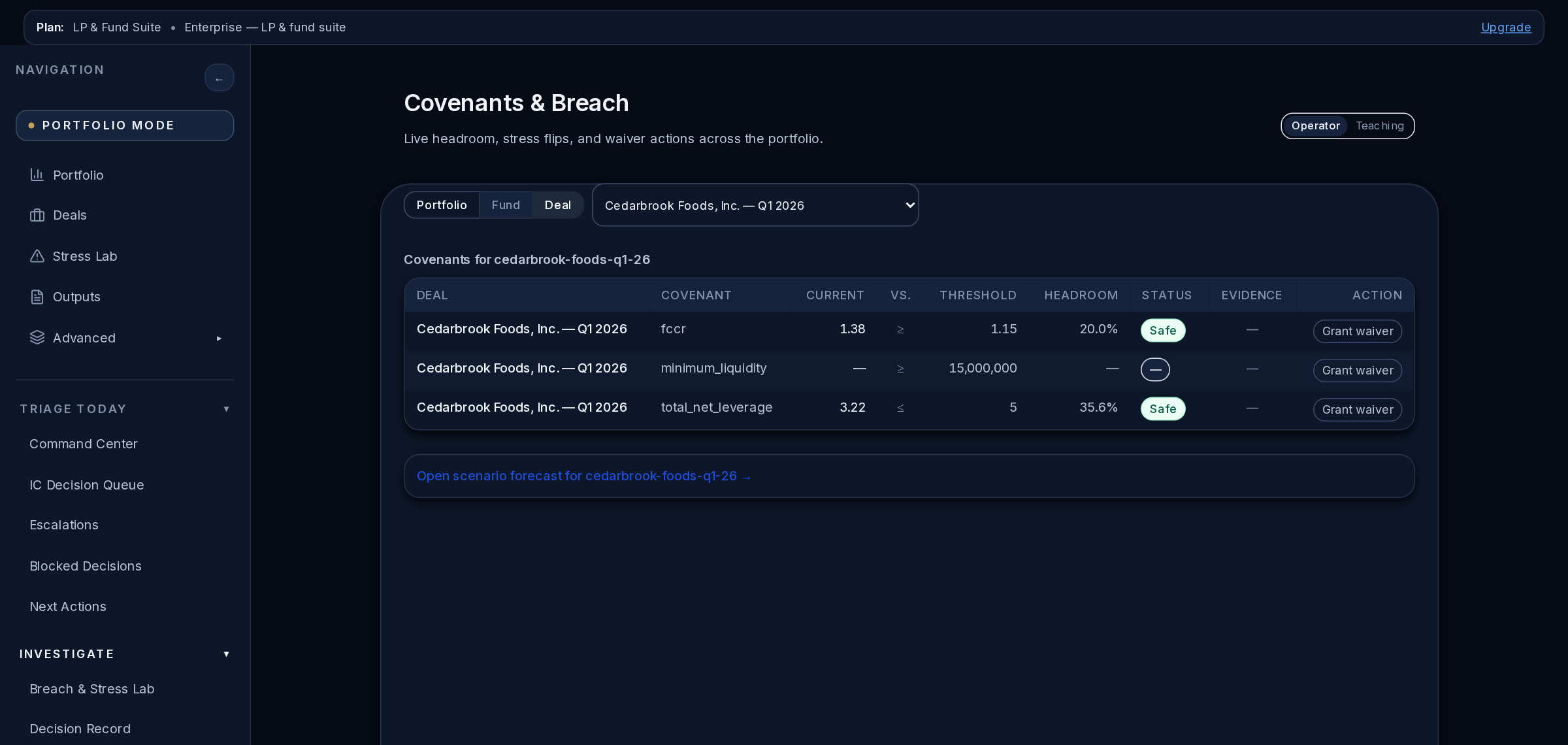
The refinance conversation starts when covenant headroom gets thin. Capital Refinery reads the total net leverage and fixed-charge-coverage (FCCR) ratios — and the cap or floor each is measured against — straight from the borrower’s compliance certificate, and shows the headroom that remains: leverage 3.22x against a 5.00x cap (1.78x of room), FCCR 1.38x against a 1.15x floor (0.23x of room). When a covenant trends toward breach, you see it on the refi calendar — with the headroom and the source page attached, not a figure transcribed from the certificate. A figure that can’t be sourced is shown blank rather than invented.
Know where the cushion actually stands.
The covenant test is preserved by changing what counts. The dashed line is the covenant; the real result has been walking toward it while the reported cushion held flat.
Pressure-test one refinancing path.
Send one position with a maturity in the next 24 months. We’ll return the refi-readiness pack — covenant trend, LTM vs. underwrite, sponsor-support options, and the operating conversations that should already be open. The partner whose name is on it deserves the calendar.