You approved one story. The company is now living another.
See the thesis break before the valuation does — the IC thesis kept alive across the entire hold.
Capital Refinery anchors the IC thesis at approval, tests drift against the entry assumptions on every data refresh, and surfaces when the thesis stops holding — before the exposure compounds into a quarterly LP problem.
This is what your IC anchor looks like, and what drift looks like against it.
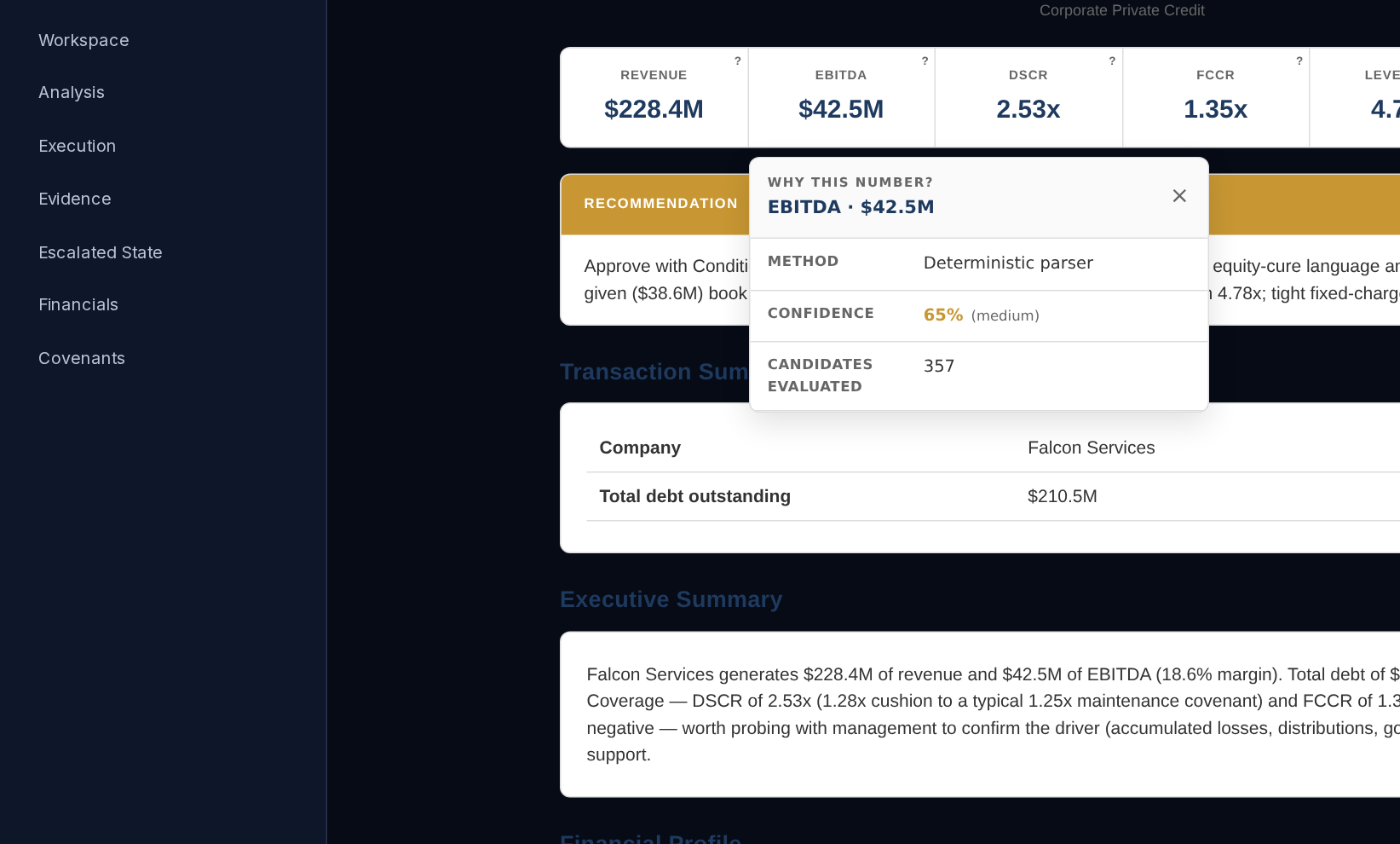
Falcon Services is a public-tenant PE/PC services deal under continuous watch posture. The IC memo below is the live artifact — IC anchor at approval, drift since IC, risk signals graded against firm policy, and the decision record. Every evidence fingerprint is independently verifiable.
This is the artifact your team sees in the morning brief, your LP sees in the quarterly pack, and your IC sees on the next-action queue. One record, one fingerprint, one source of truth across the hold period.
Five gaps every PE team is operating around.
Bain estimates $3.6 trillion of unrealized value sits on GP balance sheets, with hold periods extending into a sixth and seventh year. None of the gaps below are the team's fault — they are the structural shape of a stack that was built to collect data, not to govern decisions across that kind of timeline.
Bain & Company, 2025 Global Private Equity Report
Anchor → Drift → Decision → Defense.
The IC thesis is anchored at approval. Drift against the entry assumptions is tracked continuously. Decisions are made in a governed workflow, not an email thread. The defense survives the room changing — and the principal moving on.
Anchor the thesis at IC
The decision basis is captured to a tamper-evident record at approval.
Entry KPIs, assumptions, and thresholds are bound to the IC record at the moment of commit. The anchor does not depend on the principal remembering what was said in the room or the deck living in someone's Downloads folder.
Track drift continuously
When the company starts living a different story, the system says so.
Live operator data is reconciled against entry assumptions in every refresh. Drift surfaces by axis — financial consistency, customer concentration, key-person dependency, governance, management responsiveness — not as a single 'health' color.
Decide in a governed workflow
Pressure becomes assigned action, not another quarterly debate.
War Room narrows the view to the decisions that matter. Each option has an explicit consequence. Owners assigned, deadlines set, locked decisions reduce the queue. The team stays in control through forced resolution.
Defend the decision later
When the LP asks why the hold extended, the answer is already structured.
IC memo, board deck, evidence trail, outcome record — produced from the same data the team operated on. The defense survives partner turnover, fund-level review, and the GP-led process.
You approved one story. Here’s where it stopped holding.
Every position is re-tested against the assumptions it was approved on — not a generic threshold. When the thesis stops holding, it surfaces by axis, with a date, before it becomes a quarterly LP surprise.
The break is defined as crossing the entry assumption — what was approved at IC — not a covenant or a generic target. Leverage and FCCR are holding inside the entry case; the thesis broke on the quality of the revenue, the assumption the deal was underwritten on, while the covenants the lender watches still look fine.
No figure reaches an IC memo unless it can prove where it came from.
Drift only matters if the numbers you’re drifting from are real. Every figure Capital Refinery serves is one of three things: traceable to a source document, recorded as a contradiction between sources, or honestly absent — never a stale placeholder, never a model’s guess. Internally contradictory financials are refused at the write boundary — a leverage ratio that doesn’t equal its components, a coverage ratio that’s mathematically impossible, an equity or cash cell mislabeled as debt — so the impossible number never reaches the memo in the first place.
That standard runs as a release gate across the whole portfolio before anything ships — and the gate cannot pass by quietly dropping a failing check. It is the difference between an AI tool you have to double-check and a record you can sign under.
- ✓ All proof packs TRUTH_CLEAN
- ✓ 0 active KPI defects — across the entire deal population, not a demo set
- ✓ Negative controls reproducing · 0 lost
The release does not ship until every served figure proves itself — and the gate cannot go green by dropping a failing check.
The research behind this.
- Same engine, five readersOne record. Five readers. The unifying architecture across operator, banker, buyer, lender, LP.
- Risk Signals — observed vs firm policyThe consolidated scoreboard on every IC memo. Change a firm threshold once; every memo re-grades.
- Anatomy of one decision, end-to-endT+0 IC approval through T+540 LP review. Every primitive visible, anchored on Falcon Services Q1 2026.
- The Private Markets Decision Integrity GapFull landscape analysis. The 6-layer stack and the missing 7th.
- Why Your Monitoring Dashboard Isn't a Decision TooliLEVEL, Allvue, Chronograph, Cobalt — and the structural difference between visibility and decisions.
Same engine, different buyers.
What an operating partner actually gets.
Three things the rest of the portfolio-monitoring category does not deliver.
We sit on portfolio-company operating reality.
Direct sync to QuickBooks, Xero, NetSuite, Dynamics, Sage Intacct. When your portco CFO closes the books, your deal home sees it the next morning. Monthly cadence becomes invisible plumbing.
Which of our value-creation actions actually worked?
The platform records what you predicted, checks whether it happened, and grades the result every night. The next partnership performance conversation runs on a number, not a vibes check.
What changed, why, and which document caused it.
Side-by-side reasoning trails on every KPI. Leaf-filename attribution on every change. A refusal to soften adjudication when a lower-scoring number wins on a plausibility adjustment.
Bring us a deal you actually hold.
We'll anchor the entry thesis, surface drift since IC, and walk you through the decision-defense layer on your own diligence pack. Same day. No demo data.