The IC memo, generated from structured data — not rebuilt from memory.
Drop the source pack: CIM, credit agreement, financial model, lease abstracts. Get back a lane-aware IC memo with Risk Signals graded against firm policy, source-backed numbers, IC anchor on approval, and provenance-signed exports for LP and audit.
Lane-aware IC memo, graded against firm policy.
Every figure traces to source. Every Risk Signal carries observed value, firm threshold, verdict. The IC anchor locks the basis on approval.
From manual reconstruction to structured rendering
The IC memo is the most expensive document in private equity. Senior people spend weekends on it. Numbers drift between draft versions. Six months later, nobody can tell you exactly what was approved or on what basis. Capital Refinery replaces the rebuild with a render.
Source data ingests once. The memo dossier — five lanes deep (Corp-PC, Corp-PE, RE-PC, RE-CRE, Hybrid) — renders from structured KPIs, scenarios, and risk signals. Partners and analysts edit narrative, not formulas. Every override is versioned and audited.
Every claim source-backed
Every figure in the memo — growth trends, margin shifts, concentration exposure, covenant headroom, value creation thesis — clicks back to the underlying evidence:
- KPI source tables with candidate trail
- PDF source page with line-level reference
- Excel tab and cell lineage
- Scenario drivers and assumption history
This is what makes the memo defensible at IC, at LP review, and at audit.
The dossier triptych — what the IC actually debates
Each lane carries a structured triptych:
- What must be true — the explicit conditions the thesis depends on
- What would change — the observable signals that would invalidate the thesis
- Likely pushback — the partner / IC / LP objections the team has already addressed
The committee debates the call against the structure. No more “what is the bear case” reconstruction at IC.
Draft, refine, override — every change versioned
The memo engine generates the first pass. Humans always control the final word:
- Edit or override narrative sections
- Adjust scenario emphasis
- Insert qualitative insights from management presentations
- Reorder sections to match firm-specific memo structures
- Control tone — analytical vs strategic
Every human change is versioned and stored. Override audit trail per figure.
Multiple outputs, one source of truth
From the same structured record:
- Partner-ready IC memo (narrative-led)
- IC summary pack (number-first, decision-grade)
- Data appendix (evidence-linked KPI pages)
- Stress and scenario summary
- LP-verifiable share page (evidence fingerprint)
IC anchor on approval — the basis is locked
The moment the committee votes, the system writes an IC anchor: a tamper-evident record of every figure, every assumption, every scenario in force at that moment. Six months from now when the LP asks why this asset was approved, the answer renders from the anchor — not from somebody’s memory.
Built for every lane
- Corporate buyouts and majority investments (Corp-PE)
- Minority growth equity (Corp-PE)
- Credit and lending transactions (Corp-PC)
- Real estate single-asset and credit (RE-PC, RE-CRE)
- Roll-up / multi-operator theses (Hybrid)
- Fund-level summaries
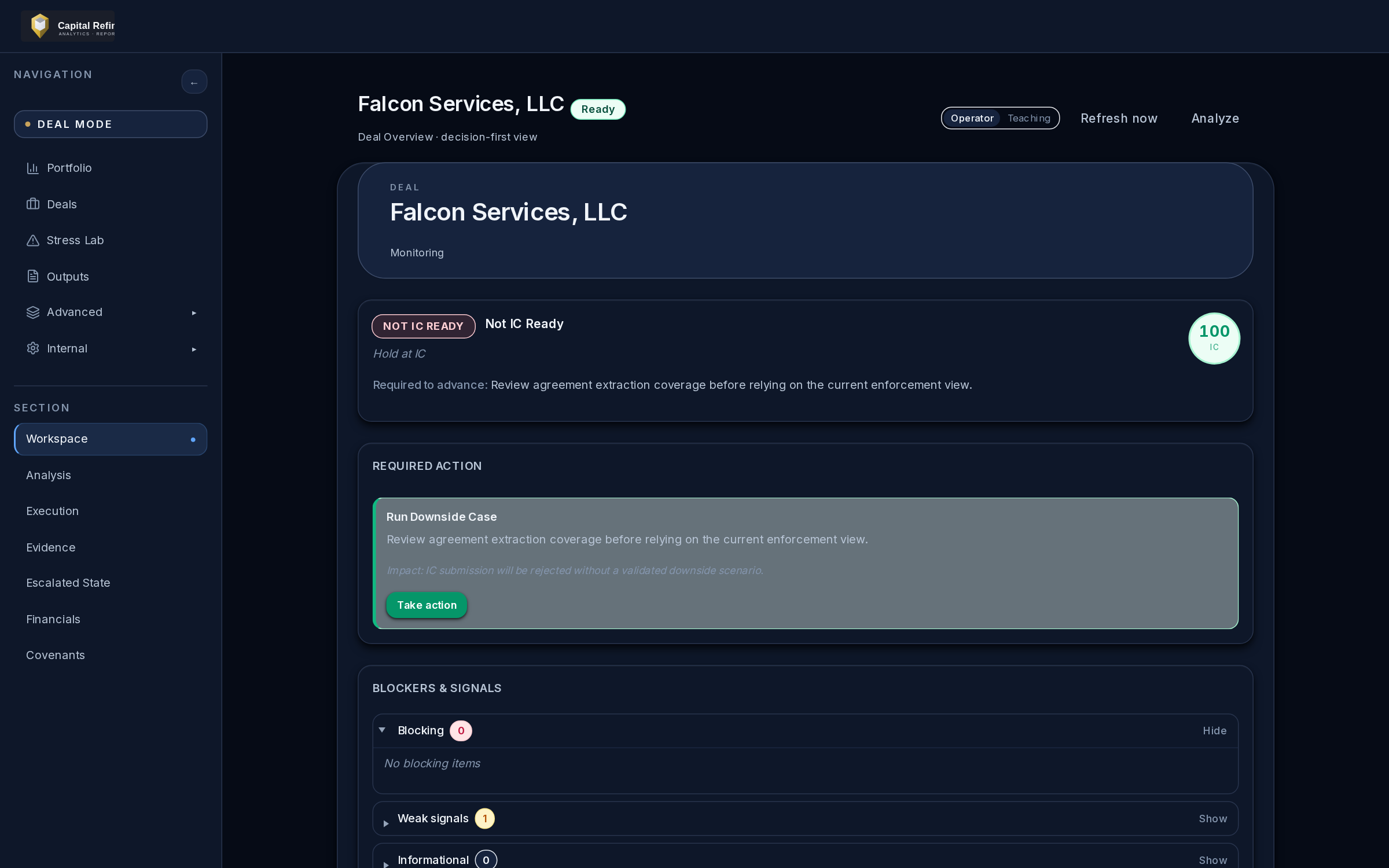
Start with the Falcon hub. The IC memo engine described above renders the Falcon dossier you’ll see at /sample-evaluation, walks under stress at /watch, and downloads as a signed pack at /sample-diagnostic.
See your next IC memo render from a real deal pack.
No demo data. Drop the same source pack you would put in front of IC. Same-day diagnostic pack back — lane-aware, source-backed, graded against firm policy.