Run an IRA on a real deal. Watch the system work.
Six steps. Real platform output at every step. Cedarbrook is a sell-side food-distribution business with strong data infrastructure and unreconciled financial conflicts — exactly the kind of company preparing for sale where a consultant engagement should land. The page below shows the initial Not Ready verdict, why it gates, what's already strong, the surgical 6-step remediation, and the Re-IRA delta in outcome language. No score theater. No magical lifts. Every grade comes from the same engine that powers a live deal.
This is the IRA assessment Cedarbrook would forward to a buyer, lender, or LP.
Inline preview below. The full assessment, executive report, IC memo, financial workbook, and KPI summary are downloadable beneath the viewer — each carries the same fingerprint and is independently verifiable.
This is the artifact a sell-side banker forwards to a buyer's IC. Same engine, same axes, same evidence standard the buy-side platform applies to their own portfolio. The portability is the product.
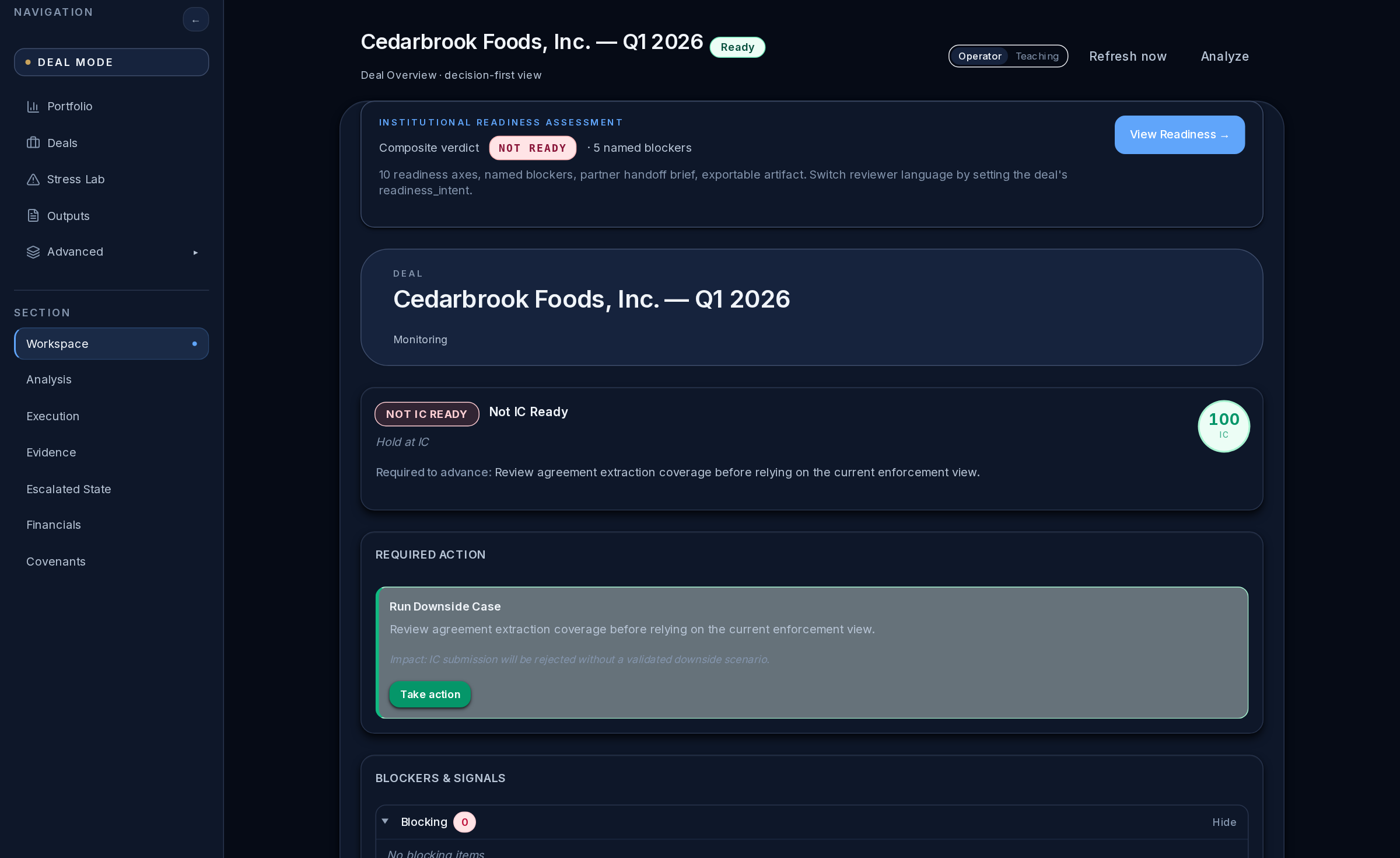
How to read this walkthrough
The page below shows real engine output, not a polished mockup. Six segments. Six things worth pausing on:
- The verdict band. Not Ready / Developing / Near Ready / Institutional Ready — bands from a deterministic grader, not a vibe-based score.
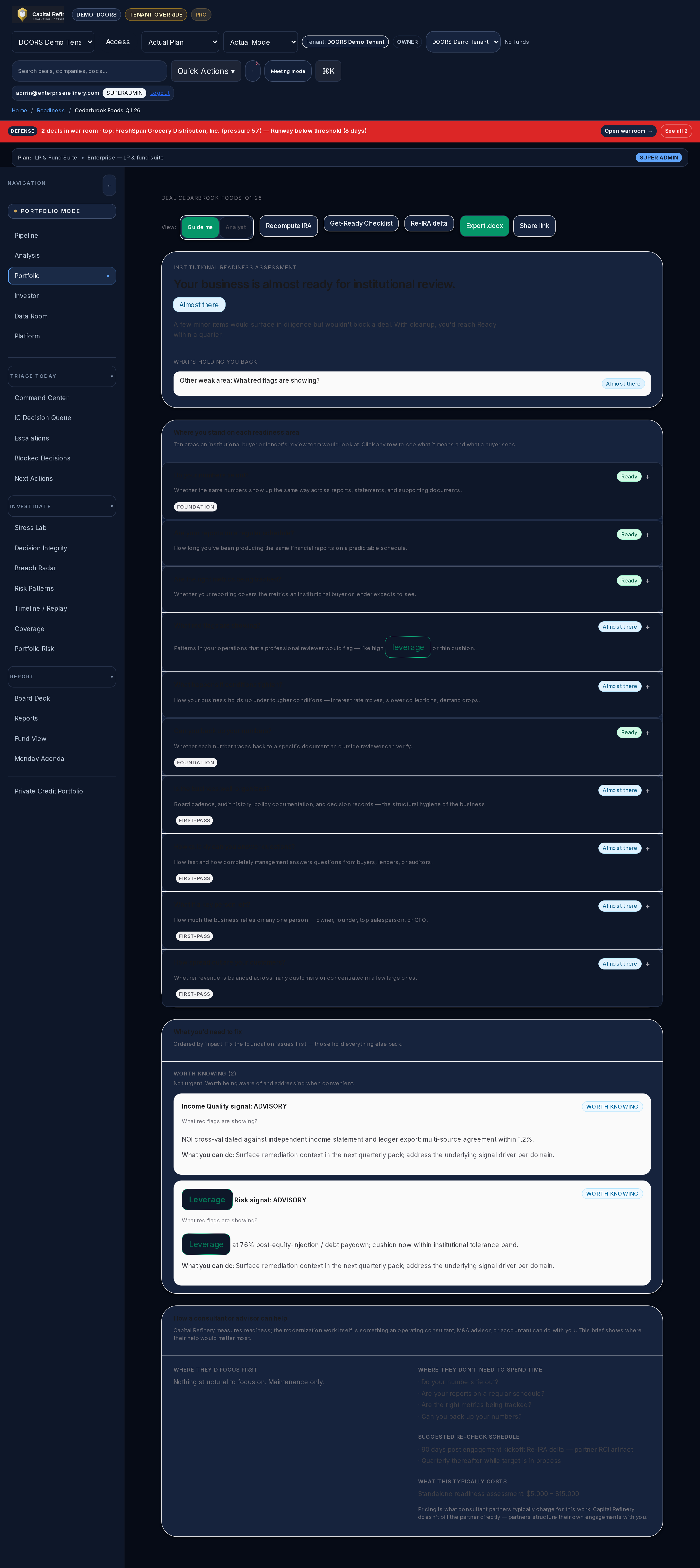
- The gating axes. Two of ten axes (data integrity, financial consistency) gate the verdict. If either is below institutional-ready, the composite cannot be promoted regardless of the other eight. That’s why a single unreconciled-conflicts axis can hold the whole verdict at Not Ready.
- The blockers. Each one is a specific, named, evidence-linked remediation — not “improve documentation.” A consultant could quote from this list directly.
- The Re-IRA delta language. Watch the wording. “7 blockers eliminated · diligence timeline compressed ~6–8 weeks · Lower-middle-market PE rollup acquirers and Senior bank financing for buyer now viable.” Never “score improved C+ to A-.”
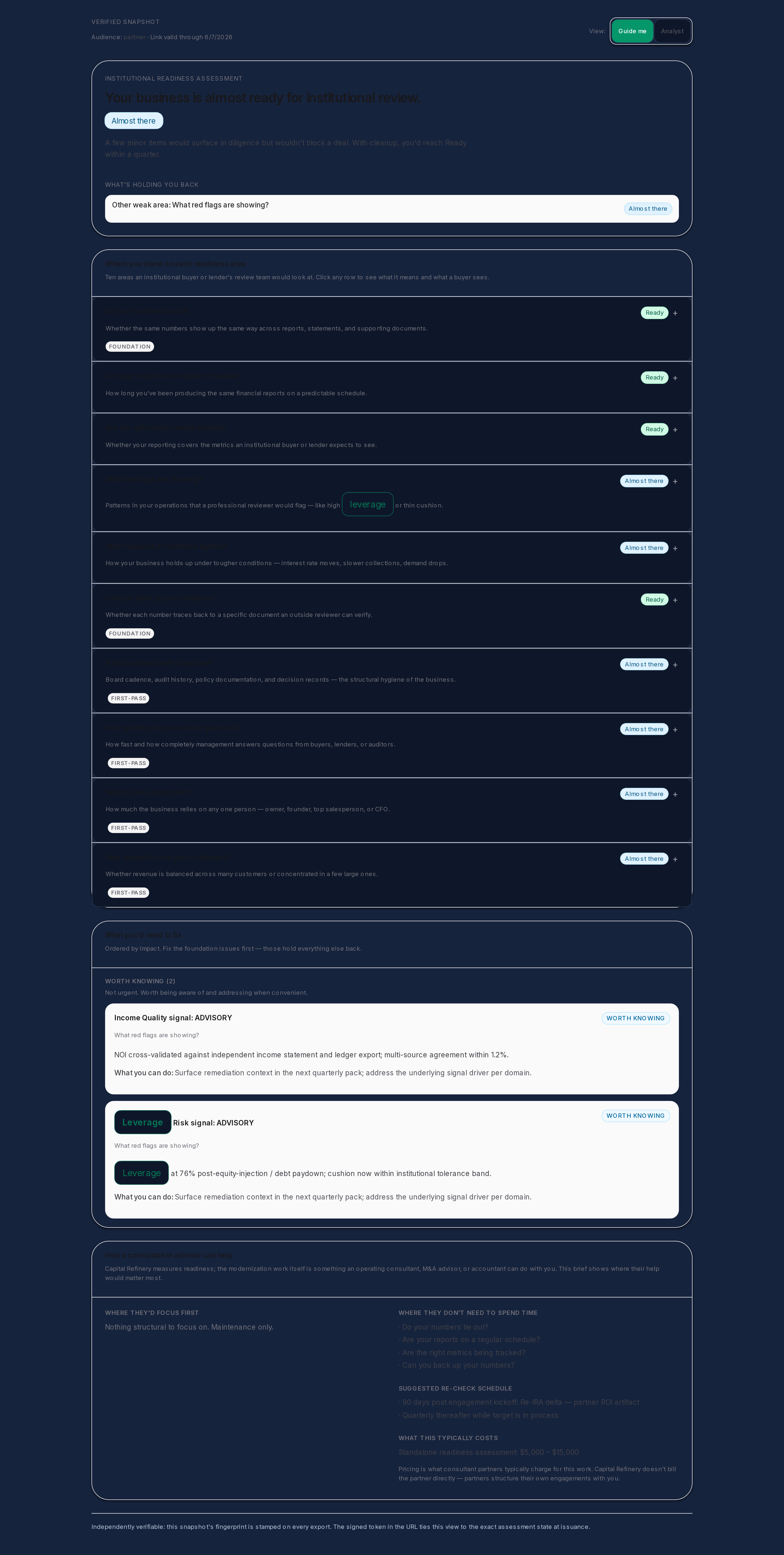
- The verification URL. Every snapshot has a public, tokenized verification page. The fingerprint on the artifact matches the fingerprint at the URL. That’s portable proof, not a PDF that lives in a partner’s inbox.
- What’s marked
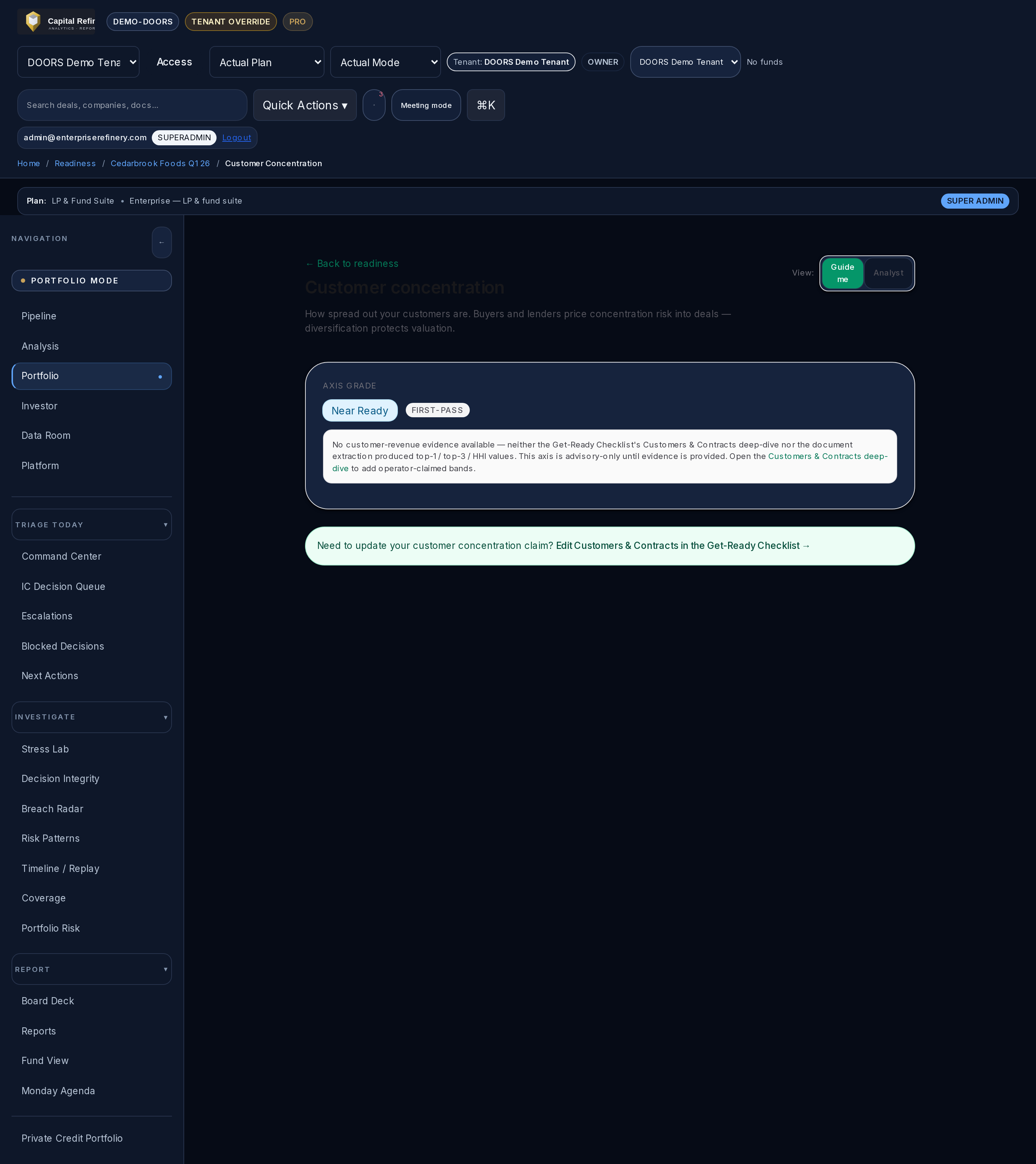
not_observable. When evidence is thin, the engine refuses to grade and says so. Look for the marker. It’s the discipline that makes the rest of the artifact credible.
If something doesn’t match between the screenshots and the underlying engine output, file a bug.
What this walkthrough proves
Most readiness products show you a polished mockup. This one shows you a real grading run on a real deal. The Cedarbrook payload powering this page is the same fixture that backs our integration tests — 2.8MB of extracted KPIs, conflicts, provenance entries, and decision gates. Every band on this page came out of grade_all_axes(), every blocker came out of derive_named_blockers(), every delta came out of compute_ira_delta(), and every screenshot on this page came out of the live platform UI rendering those exact engine outputs. If you find a number that doesn't add up, file a bug.
- GateProvenance coverage at 89.7%Data integrity
- Gate5 unreconciled critical-KPI conflict(s)Financial consistency
- BlkMissing required categories: corp_collateralKPI completeness
- BlkIncome Quality signal: BLOCKEROperational risk
- BlkLeverage Risk signal: WARNOperational risk
- BlkReporting cadence / period coverage limitedReporting maturity
- BlkStress tolerance: thin cushion (provisional)Stress tolerance
- Financial consistencyGateNot Ready6 unreconciled conflicts (5 critical: dscr, fccr, revenue, ebitda, totaldebt)
- Data integrityGateDevelopingProvenance coverage 89.7% across 58 promoted KPIs
- Reporting maturityDevelopingSufficiency status: thin (75/100)
- KPI completenessNot ReadyCoverage 65/100, missing: corp_collateral
- Operational riskNot Ready1 blocker · 1 warn · 0 advisory
- Stress toleranceDevelopingLeverage signal HIGH · provisional
- GovernanceAdvisoryNear ReadyAdvisory placeholder — graded once observation period or signal-collection layer lands
- Management responsivenessAdvisoryNear ReadyAdvisory placeholder — graded once observation period or signal-collection layer lands
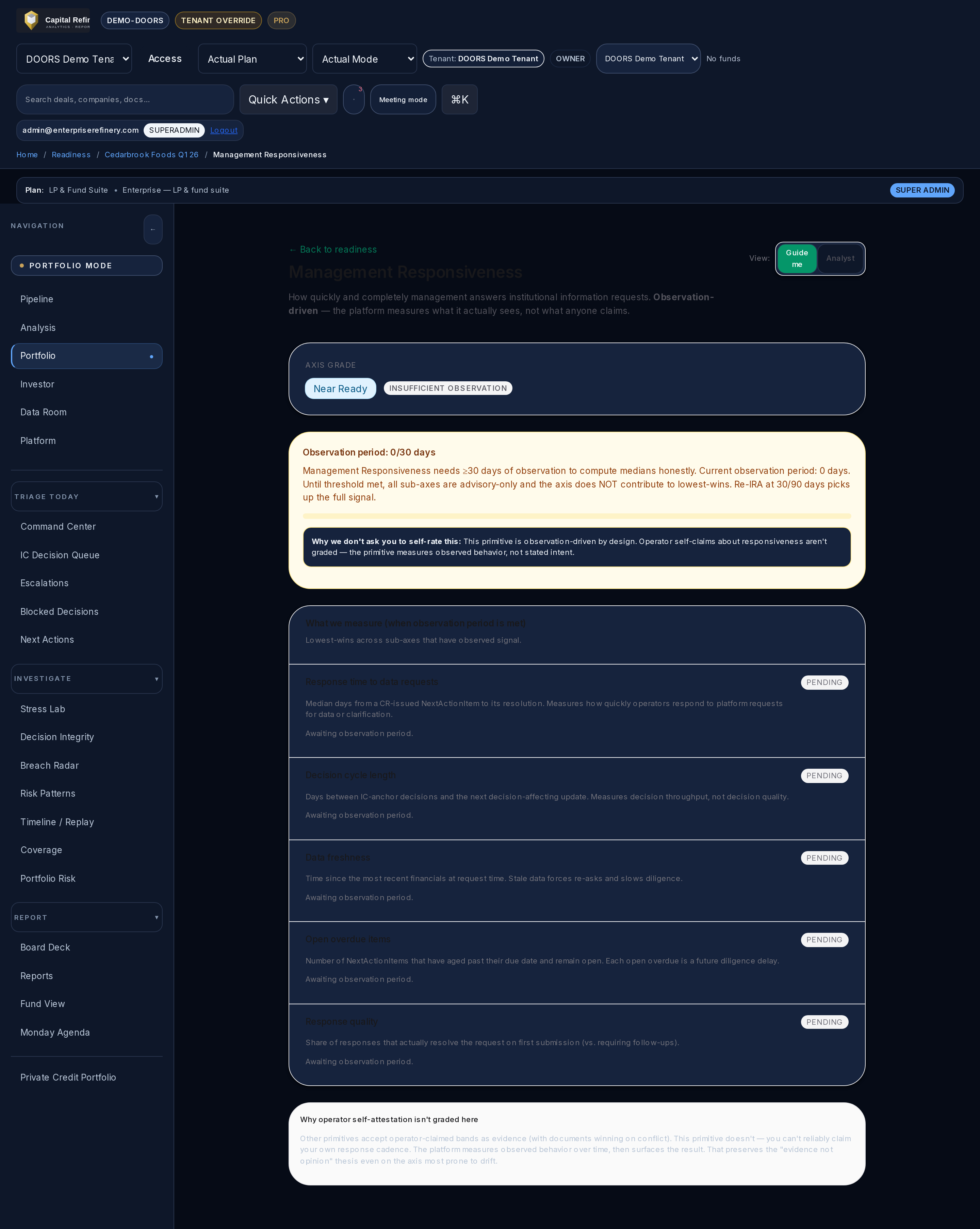
- Key-person dependencyAdvisoryNear ReadyAdvisory placeholder — graded once observation period or signal-collection layer lands
- Customer concentrationAdvisoryNear ReadyAdvisory placeholder — graded once observation period or signal-collection layer lands
| KPI | Winner | Winner method | Contested | Alt method |
|---|---|---|---|---|
| FCCR | 1.30x | derived | 1.38x | deterministic |
| Revenue | $147.2M | derived | $26.2M | deterministic |
| EBITDA | $46.5M | derived | $1.8M | deterministic |
| Total Debt | $158.2M | derived | $164.8M | deterministic |
| Net Income | $16.8M | derived | $1.7M | deterministic |
- 01Reconcile the 5 critical KPI conflictsPull the source documents behind each disputed extraction; identify why two methods diverged; either retire the alt-method extraction (stale label, header row mistaken for value) or document the discrepancy so the engine can promote the correct figure deterministically.Targets:Financial consistencyExpected band shift: NOT_READY → INSTITUTIONAL_READY
- 02Document the corp_collateral packageThe KPI-Completeness axis flags missing collateral coverage. Supply the collateral schedule, lien filings, and (where applicable) appraisal evidence. Coverage rises from 65 → 96, sufficiency_status flips from thin → robust.Targets:KPI completenessReporting maturityExpected band shift: DEVELOPING → INSTITUTIONAL_READY (kpi); DEVELOPING → NEAR_READY (reporting)
- 03Cross-validate NOI against an independent income statementOperational Risk fires income_quality at BLOCKER because NOI is single-sourced. A second-source attestation (independent income statement, ledger export, or accountant-confirmed schedule) closes the cross-validation gap and clears the blocker.Targets:Operational riskExpected band shift: NOT_READY → NEAR_READY
- 04Backfill the 6 missing provenance entriesSix promoted KPIs lack matching kpi_provenance entries. The engineering work is small (the source documents already exist) but the institutional payoff is real: provenance coverage rises from 89.7% → above 95%, lifting Data Integrity out of Developing.Targets:Data integrityExpected band shift: DEVELOPING → NEAR_READY
- 05Strengthen the equity cushionStress Tolerance grades the leverage_risk signal as HIGH (93.3% leverage). An equity injection, debt paydown, or refinance that drops leverage into the 70-80% band shifts the signal to MEDIUM and the axis to Near Ready.Targets:Stress toleranceExpected band shift: DEVELOPING → NEAR_READY
- 06Institutionalize the close cadenceReporting Maturity grades on cadence + period coverage. Establishing a monthly close discipline with 12+ trailing months of consistent statements — and supplying that evidence to the platform — lifts the sufficiency status to robust.Targets:Reporting maturityExpected band shift: DEVELOPING → NEAR_READY (paired with collateral package)
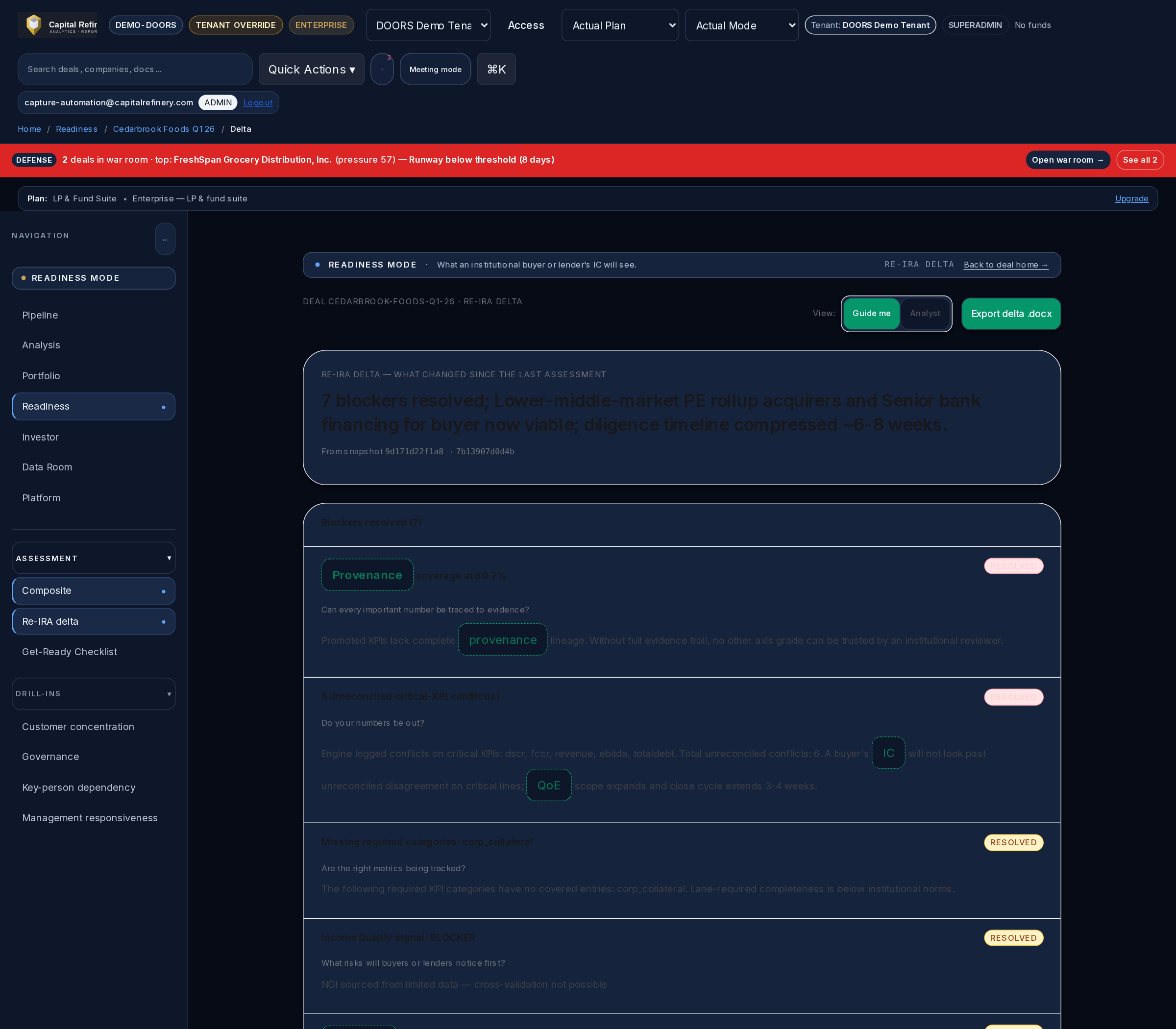
- ResolvedProvenance coverage at 89.7%Data integrity
- Resolved5 unreconciled critical-KPI conflict(s)Financial consistency
- ResolvedMissing required categories: corp_collateralKPI completeness
- ResolvedIncome Quality signal: BLOCKEROperational risk
- ResolvedLeverage Risk signal: WARNOperational risk
- ResolvedReporting cadence / period coverage limitedReporting maturity
- ResolvedStress tolerance: thin cushion (provisional)Stress tolerance
- Lower-middle-market PE rollup acquirersMeets institutional rollup floor; fits standard add-on diligence pattern
- Senior bank financing for buyerReporting + provenance threshold supports senior debt underwriting
- Family-office buyers with operator backgroundsFoundation issues resolved; broader family-office pool becomes engageable
- · QoE scope contained pre-LOI; EBITDA reconciliation no longer extends close cycle
- · Trailing-period reporting evidence sufficient for diligence team review
- · Required KPI back-fill no longer needed during diligence
- · Risk Signals scoreboard does not auto-flag in committee review
- · Lender stress-test pricing adjustment minimized
- · Provenance trail complete for institutional reviewer tie-out
Different from a consulting deck
A McKinsey, BCG, or boutique readiness deck and an IRA artifact look superficially similar — both bound, both have charts, both name remediations. The differences are the parts you usually can’t see:
- Causality. A consulting deck claims the consultant caused the improvement. The IRA refuses that claim. It measures what changed between two evidence-backed snapshots; causality belongs to whoever did the work.
- Reproducibility. A consulting deck is regenerated by writing it again. The IRA is regenerated by re-running
compose_ira()on the new evidence. Same engine, same axes, same thresholds — only the inputs changed. - Missing data. A consulting deck imputes when data is thin and reads confidently regardless. The IRA marks the sub-axis
not_observableand refuses to grade. Worse-looking, harder to fake, more credible to a sophisticated reviewer. - Refused inputs. A consulting deck reads management presentation polish, narrative coherence, and tone as evidence. The IRA refuses sentiment, polish, and narrative as graded inputs — only documents and elapsed-time signals count.
- Verification. A consulting deck is a document. The IRA artifact is a document plus a public verification URL plus a deterministic fingerprint. A buyer can confirm independently that the snapshot wasn’t edited.
What is intentionally not claimed
The credibility comes from what the engine refuses to do. The refusals are not editorial — they’re structural, enforced by the grading code, and they hold for every assessment, not just Cedarbrook.
- No AI maturity score. We do not score “AI readiness” or “digital transformation maturity.” Those are vibes wearing a number.
- No causality claim. We do not claim a consultant or operator caused the improvement. Causality belongs to the people who did the work.
- No imputation. A missing input means
not_observable, not a default zero. Imputing to make a band look better is the failure mode the discipline is designed to prevent. - No narrative grading. We do not grade management communication style, presentation polish, or narrative coherence. LLM-derived sentiment scores on human prose are opinion in numeric clothing.
- No outcome guarantee. The Lift Ledger reads in observation language, not promise language. “EBITDA moved from $8.0M to $12.5M” is provable. “Our work caused 18% growth” is not.
- No customer claim. Cedarbrook is not a customer. It’s a realistic middle-market fixture used to validate the methodology end- to-end on real-shaped data — exactly what an early-stage product should disclose. Most early-stage products would dress this up as a “client engagement.” The artifact loses institutional weight the moment it does.
That last bullet is the one most early-stage products refuse to write. We’re writing it on purpose.
What you just read
A buyer or lender reviewing this page sees the system from the seller's side. They see a deterministic verdict that would survive their own institutional review. They see the remediations a consultant could quote, sequence, and prove. They see a delta artifact written in the language of institutional outcomes — eliminated blockers, cleared gates, unlocked counterparty classes — never “score improved.” And they see a verification URL that turns the artifact into something portable, not something marketing-shaped.
That is the difference between a readiness product and an institutional measurement layer.
Where this fits
Cedarbrook is the proof case. The same engine drives three paid surfaces:
- Readiness Gap Review. $4,500. Five business days. Top-five blockers a sophisticated buyer or lender would surface first. Credit toward a full IRA within 60 days. For owners and advisors preparing for sale or financing.
- Modernization Impact Review. $3,500 baseline + $2,500 Re-IRA delta. Independent measurement layer attached to AI / automation / fractional-CFO engagements. Partner-as-agent legal frame.
- Full Institutional Readiness Assessment. Transaction-priced. The complete 10-axis grade with public verification token, partner brief, and the Lift Ledger you see on this page.
The methodology is the same in all three. The packaging differs by audience — operators, partners, transaction prep.
The buy-side counterpart
Cedarbrook is the sell-side proof case — an operating company graded for institutional readiness ahead of sale or financing. The same engine runs the buy-side: an acquirer’s IC underwriting a deal, a lender’s credit committee testing a borrower, an LP reviewing fund governance. Falcon Services Q1 2026 is the buy-side walkthrough — the IC dossier, the per-cell provenance, the stress lab, the covenant forecast, the decision lifecycle — all rendered by the same engine that graded Cedarbrook.
Same engine. Same 10 axes. Same fingerprint discipline. Different lens.
See your own deal under the same engine.
The composite verdict, the named blockers, the partner-handoff brief, and the verification artifact — all on a real deal you bring to us.

Built by Duaine McDonald, an AI strategist and fractional Chief AI Officer with 20+ years across enterprise automation, transformation, governance, and AI strategy. The consulting practice runs separately as Enterprise Refinery; Capital Refinery is the software layer that came out of those conversations — the institutional measurement artifact operating companies, advisors, and investment teams kept asking for and could not find anywhere else. Early engagements are reviewed directly by the founder.
Capital Refinery is early. We do not show customer logos we have not earned.
Instead, we show the methodology, two fixture-based proof cases (one per audience), the verification flow, and the live artifacts a buyer, lender, board reviewer, or advisor would inspect. Most early-stage products would invent a logo wall. We refuse on purpose — the same discipline that makes the artifact credible.