Find out the thesis broke while there's still time to act.
One governed loop carries the investment decision forward — signal to scenario to intervention to output. Every IC approval lands in a structured record. Every operator update tests whether the original assumptions still hold. The moment they don't, the team finds out — with the time still left to act.
Signal → Scenario → Intervention → Output.
Each stage hands the investment record to the next without losing context. The same thesis that closed the deal is the thesis the platform tests against in year three.
- 01
Signal
Know what is moving before the meeting starts.
The structured record ingests operator data continuously — accounting feeds, KPIs, covenants, and narrative. Every datum is mapped to the assumption it tests. When conditions change, the platform surfaces it: which positions are deteriorating, which decisions are stale, which actions are overdue. That is the morning triage.
- 02
Scenario
Run downside fast enough to shape the conversation.
Shock packs, Monte Carlo scenarios, breach probability, and time-to-consequence ranking run on the live record — not on a quarterly snapshot. The team sees, on the positions they actually hold, how much room is left before a covenant breach or a thesis assumption breaks. The diagnostic the monitoring tools never had.
- 03
Intervention
Turn signal into governed action, not another follow-up thread.
When pressure is live, the platform narrows the view to the decisions that matter right now. Each option has an explicit consequence. Owners are assigned. Deadlines are tracked. Locked decisions reduce the queue. The team stays in control through forced resolution — not consensus theater or email chains.
- 04
Output
The decision basis survives the room changing.
IC memo, board deck, evidence trail, outcome record — produced from the same data the team operated on. Every figure traces back to the source document. Every decision is recorded with its reasoning, its alternatives, and what the team knew at the time. The IC memo itself carries a Risk Signals scoreboard: portfolio LTV, concentration, expense creep, debt-service runway, lease and title risk — observed against firm policy on every render. Change a firm threshold once, and every memo reflects the new standard.
Three engineering choices that make the loop possible.
This loop is not a UX layer over a monitoring tool. It requires a particular extraction model, a particular data model, and a particular feedback loop. We made all three deliberately.
Deterministic-first extraction
Deterministic parsing is the brain. The local LLM is a thin adjudication layer.
Three-pass kernel: regex sweepers identify candidates, deterministic constructors assemble the structured figures, and a small local model adjudicates conflicts. Every figure has a method, a candidate ID, and a provenance trail. There are no hallucinated KPIs because the LLM never invents one — it only chooses between candidates the deterministic layer already produced.
Live decision validity
Every decision is testable, all the time.
The thesis, the assumptions, and the conditions are all structured at IC. As operator data flows in, every assumption is re-tested against the latest values. Decision validity is scored on every position and re-evaluated against the latest data each time the position is opened — not a quarterly check-in from a separate monitoring tool that does not know what the IC decision was.
Closed operating loop
Accounting → signals → variance → action → outcome → next cycle.
Data ingestion is not the goal. The closed loop is. Variance is escalated to the right person on the team. Decisions and overrides are recorded with their reasoning. The next cycle starts informed by what the last cycle learned. The IC record stays alive, and so does the team's institutional memory of why they did what they did.
The workflow, on real positions.
Every screenshot is from a live seeded portfolio. The same data the demo runs on — no mockups, no placeholder figures.
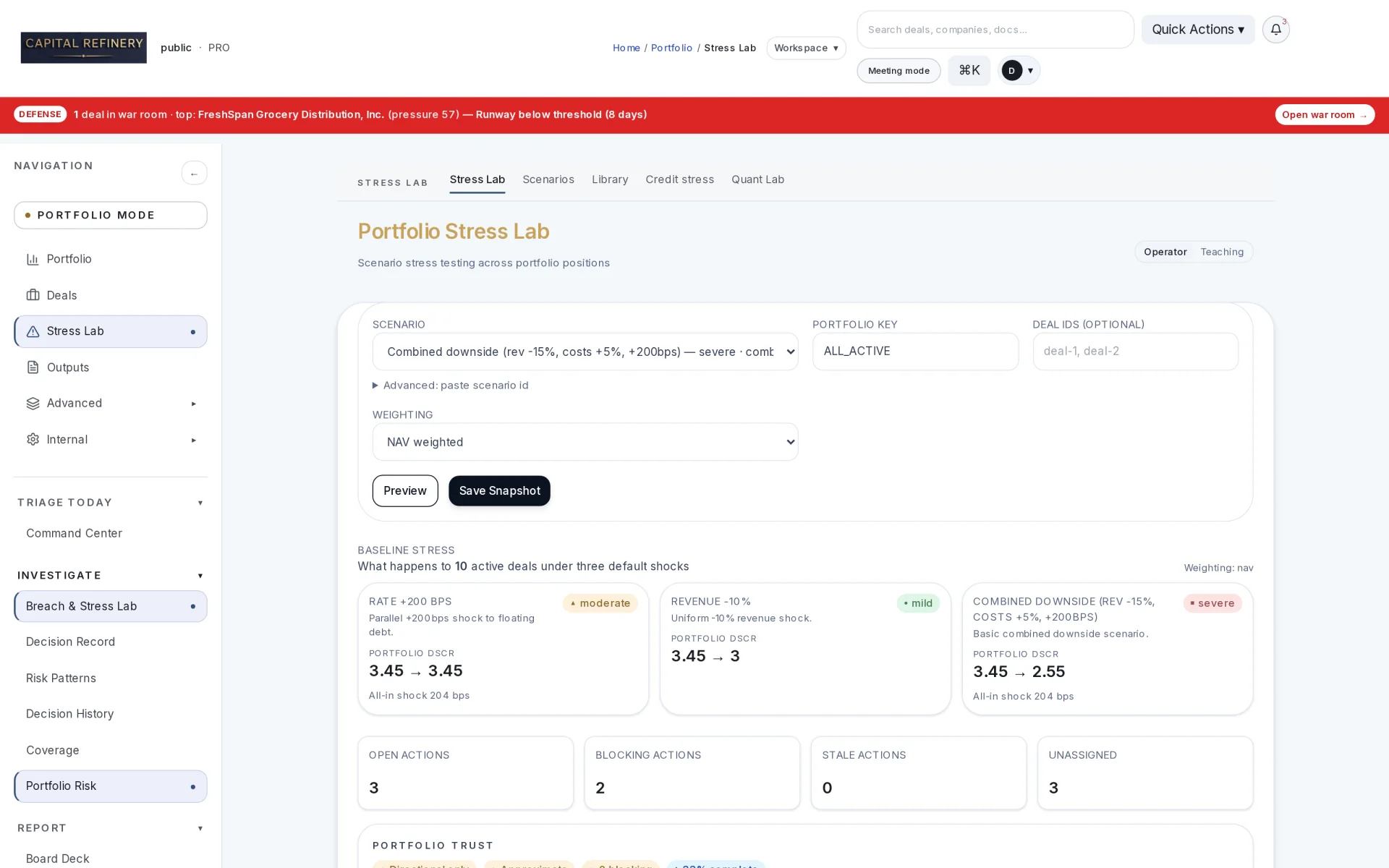
Named scenario or custom. Severity controls how hard the propagation hits every position.
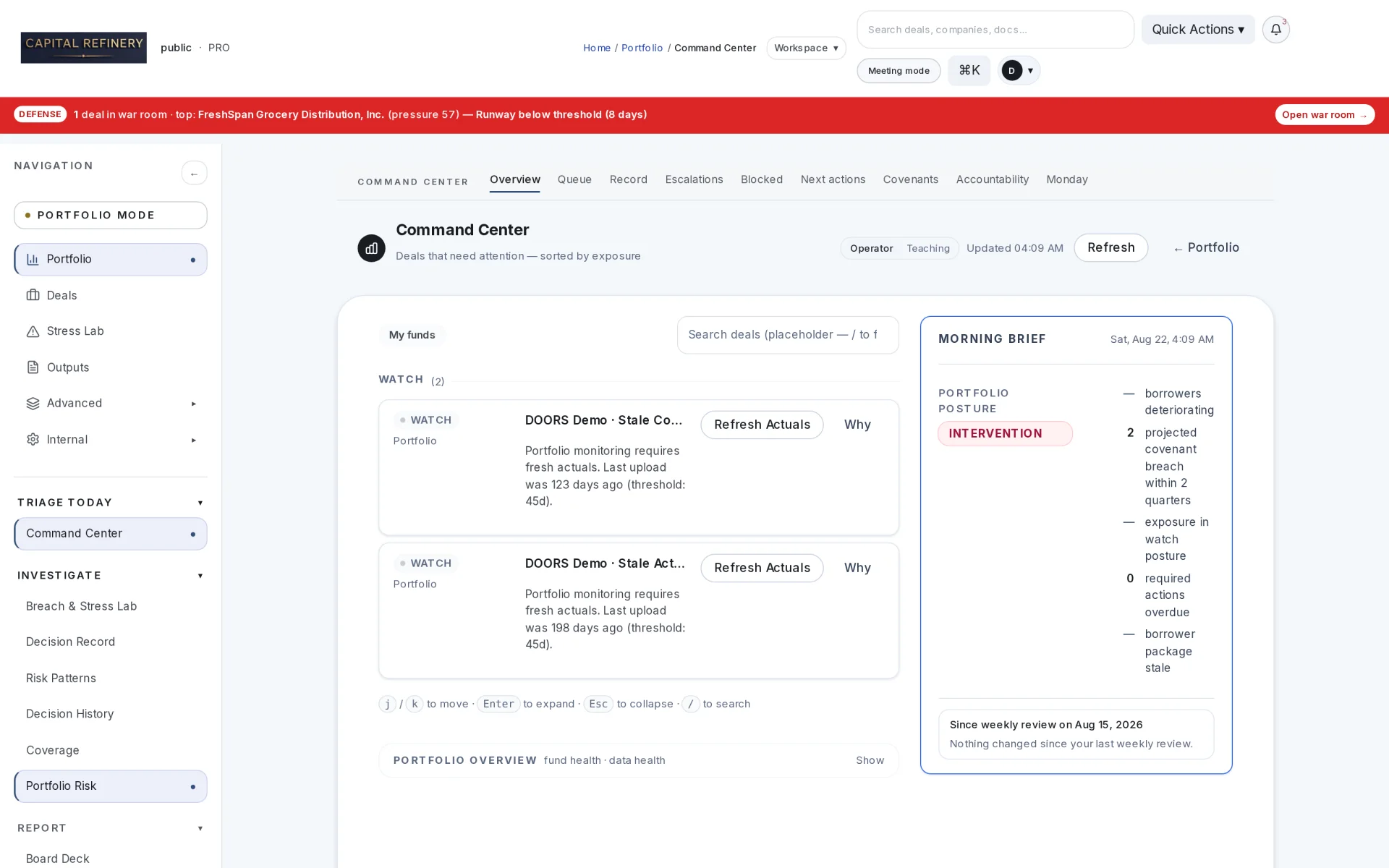
Portfolio health, open decisions, overdue actions. The morning starts here.
Portfolio pressure, deal control, War Room containment, and outcome continuity. Every stage of the loop on live positions, uncut.
Three things the platform refuses to do.
Most software grows by adding features. Capital Refinery is held together by enumerated refusals — system-level behavior that competitors leave to operator discipline (and therefore to slippage).
When the portfolio company's accounting is unlinked, the platform won't accept an IC approval. It names exactly what's missing — connect QuickBooks, Xero, NetSuite, Dynamics, or Sage Intacct, or upload an actuals file — and refuses to advance until one of those happens. No soft warning to ignore. No override field to abuse.
Defense mode is a tracked deal state the system manages — not a button anyone can press. There is no view-only mode. The decision to open War Room belongs to the platform, not to a user trying to look busy.
When two candidate numbers compete and the lower-scoring one wins on a plausibility or outlier adjustment, the "Why this number?" overlay says so out loud — names the adjustment that promoted the winner instead of pretending the winner simply "exceeded" the alternative. A test catches any attempt to soften it.
The architecture underneath, named.
The wedge is continuous borrower monitoring. Underneath sits a governed decision loop that holds itself accountable for the decisions you make on top of it.
The platform that grades itself
The system tracks what you predicted, checks whether it happened, ages your decisions until they're no longer correct, and refuses to let stale data convene IC. The closed loop, named.
Every signed memo, audited against current reality
Automatic reclassification of every distributed artifact the second a new IC commits. The LP DDQ governance section answers itself.
Move a threshold, re-grade the portfolio tonight
Eleven explicit policy thresholds. Your firm policy as a live setting the platform reads, not a Word document on a shared drive.
We sit on operating reality, not vendor data licenses
Direct sync to portfolio-company accounting and banking. When the CFO closes the books, your deal home sees it. Monthly cadence becomes invisible plumbing.
What changed, why, and which document caused it
Side-by-side reasoning trails on every KPI, leaf-filename attribution on every change, and a refusal to soften its own adjudication when a lower-scoring number wins.
When documents disagree, a human decides
Cross-document conflicts and password-protected uploads become review items with the competing values as one-click choices — resolved by an operator, audited forever, cleared automatically when the arithmetic ties.
The committee debates the call, not the numbers under it
Lane-aware IC memo, Risk Signals scoreboard, source-backed figures, IC anchor on approval, drift tracking after the room votes.
LP packs the LP can verify
LP and board materials generated from the same structured record that drove the IC decision. Every figure traces to source.
Probability of breach — only as credible as the inputs
Covenant breach probability, DSCR runway, liquidity headroom — with the inputs standardized first.
The data room dies at close. The decision has to outlive it
Ingests the data room, extracts source-backed KPIs, grades against firm policy, and locks the basis at IC.
Capital Refinery also runs the sell-side. Operators, advisors, and bankers preparing for institutional review use the same engine to grade themselves before a buyer does. See institutional readiness →
See it on a deal from your portfolio.
No demo data. We work from your actual diligence pack and show you, on one of your live positions, where the decision validity window is closing.