Probability of breach — only as credible as the inputs.
When base/upside/downside cases are not enough, Monte Carlo gives the IC a distribution: probability of covenant breach, of DSCR falling below 1.0x, of liquidity dipping under threshold. Capital Refinery makes that credible by standardizing inputs first and tying every assumption to source.
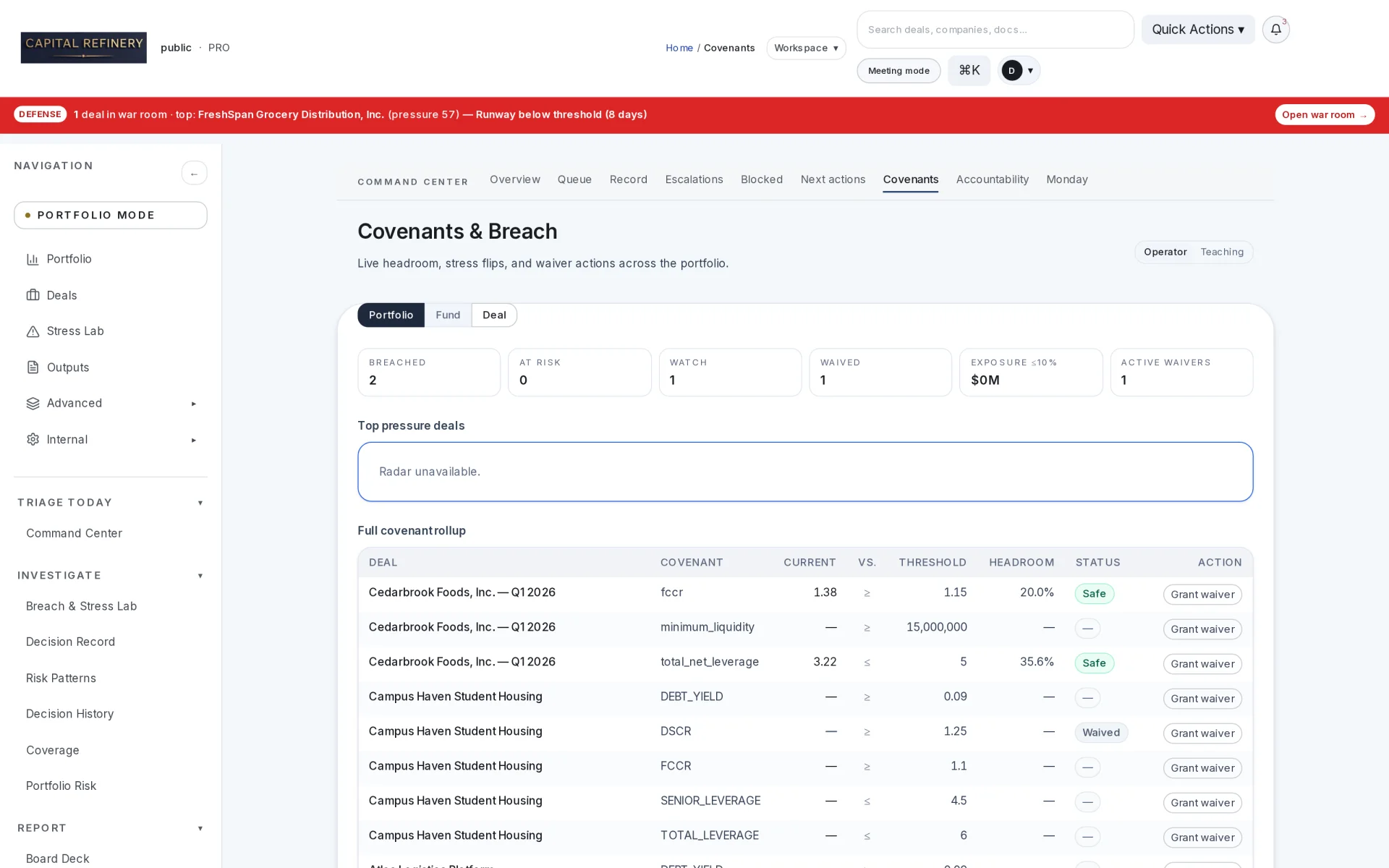
Breach Radar — probability ranking across the portfolio.
Every position ranked by Monte Carlo probability of break. Click any row, see the assumptions, the source, and the time-to-consequence.
What teams actually need from Monte Carlo
Distributions, not opinions. Instead of arguing about one downside number at IC, the room sees the range: probability of covenant breach within 12 months, probability of DSCR falling below 1.0x in the next four quarters, probability of liquidity runway dipping under threshold.
Assumptions you can defend. Monte Carlo is useless when the assumptions are hand-waved. Capital Refinery links every key driver back to source — extracted figure, candidate trail, override basis. The IC can challenge any input and trace it.
Comparable across the portfolio. Private assets come with messy reporting. We normalize KPIs against firm policy first, so probability outputs are comparable across companies, properties, and funds.
What the IC actually asks when downside gets real.
| Capability | Inputs | Capital Refinery |
|---|---|---|
| Covenant breach probability | EBITDA / NOI variance, rate paths, amortization | Drives structure, pricing, cure rights, monitoring cadence |
| DSCR runway | Cash flow stress, rate scenarios | Drives reserves, revolver sizing, intervention triggers |
| Liquidity headroom | Cash conversion, capex, working capital volatility | Drives reserves and intervention timing |
| Exit value sensitivity | Growth / margin dispersion, multiple ranges | Drives underwriting confidence and hold period risk |
| Portfolio concentration | Correlation assumptions across assets/sectors | Drives risk limits, hedging, rebalancing priorities |
Why this only works on top of structured data
Monte Carlo on a spreadsheet model produces a distribution. It does not produce credibility. The IC question that kills it is “where did this volatility assumption come from?” If the answer is “the analyst typed it in,” the simulation does not survive scrutiny.
Capital Refinery anchors every input to source. Volatility comes from extracted historicals. Rate paths come from named curves. Override decisions are versioned with basis. The IC sees the distribution and can defend every parameter under it.
Make Monte Carlo credible — starting with one position.
No demo data. Bring us a deal pack and the historicals. Same-day Breach Radar showing the breach probability, DSCR runway, and time-to-consequence with every assumption source-backed.