Run downside fast enough to shape the conversation.
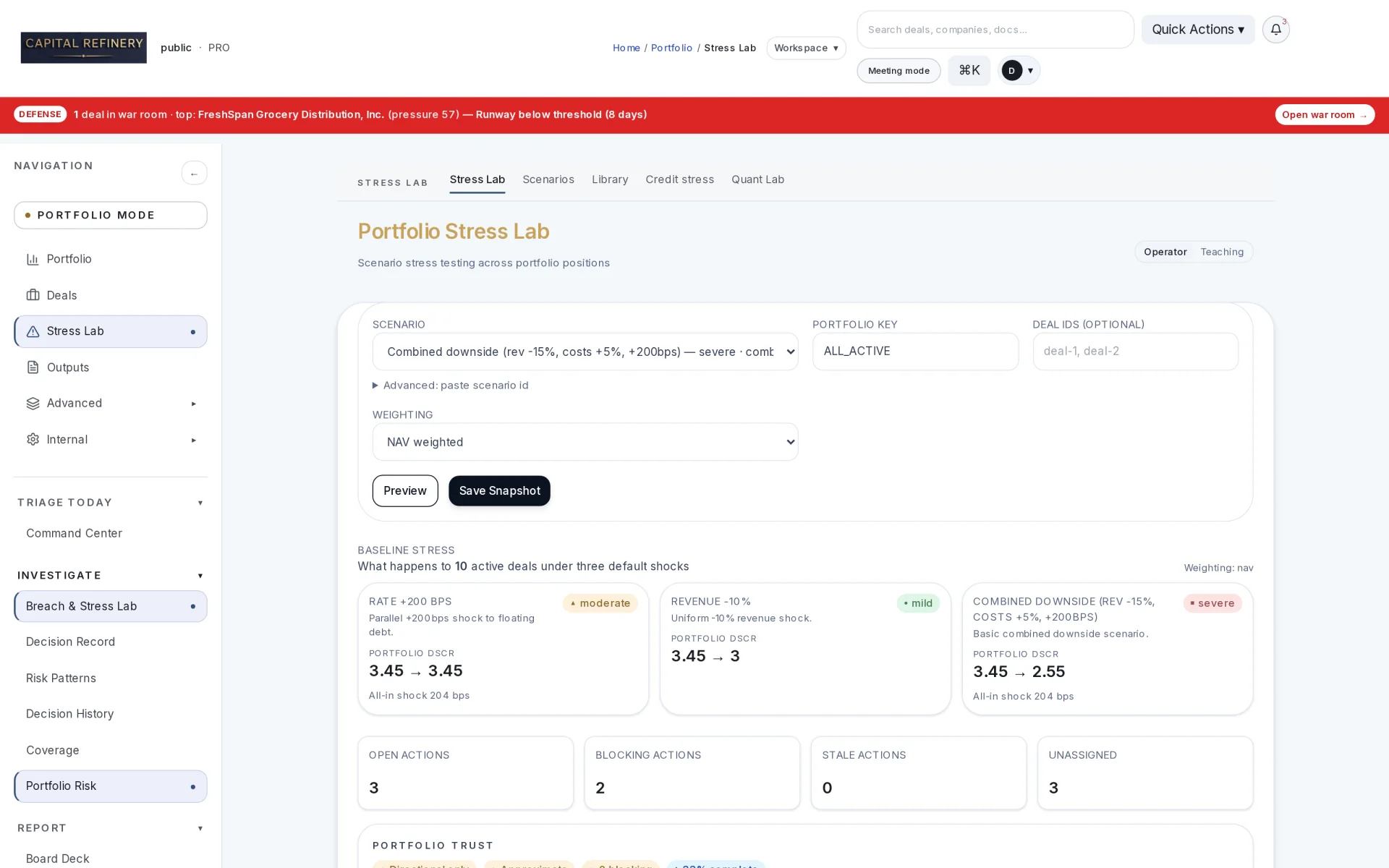
Stress Lab propagates shock scenarios across the portfolio in one pass. Breach probability, time-to-consequence, fund-level concentration. Pick a scenario, see what breaks, know how hard and where it spreads — before the lender call, not during it.
Stress Lab — portfolio-wide downside in one pass.
Pick a named scenario. See break order, breach probability, fund impact. No spreadsheet rebuild. Same KPI definitions across every position.
What’s broken about stress testing today
Stress tests are theater. Run ad-hoc, on stale numbers, with definitions that change by deal team. The IC cannot compare results across positions, so the IC cannot trust them.
Every scenario is rebuilt. Teams re-create the same cases (rate shock, demand collapse, wage inflation) in spreadsheets. The “model” is whoever last edited it.
Evidence gets lost. When the IC asks “where did that assumption come from,” the answer is buried in a PDF, an email, or a cell comment nobody can defend.
How Stress Lab works
Capital Refinery normalizes the inputs first — same KPI definitions, same source-backed numbers, same firm-policy thresholds across every position. Stress scenarios then run consistently across the portfolio in one pass: extract → normalize → grade → propagate shock → rank by break order.
Not LLM summaries of what could happen. Structural propagation across structured data.
What you can run today
- Coverage and DSCR shock — across credit and RE positions
- Rate path scenarios — fed funds curve and SOFR shifts propagated to debt service and cap protection
- Revenue / margin compression — graded by sector cohort
- Tenant rollover concentration — RE-CRE specific
- Covenant headroom Monte Carlo — probability of breach within window
- Multi-fund rollups — fund-level concentration across positions
Spreadsheet stress vs Capital Refinery.
| Capability | Spreadsheet process | Capital Refinery |
|---|---|---|
| KPI consistency | Definitions drift by deal/team | Unified KPI model — same definition every position |
| Evidence | Buried in files, hard to defend | Every figure clicks back to source cell |
| Speed | Days/weeks to rebuild scenarios | One pass across the portfolio |
| Governance | “The model is the person” | Analyst approval gates, override audit trail |
| IC readiness | Inconsistent outputs, narrative gaps | IC-ready downside narrative, source-backed |
| Drift since IC | Manual reconstruction quarter to quarter | “Since IC” renders against the anchor |
How firms deploy this
Week 1 — Pick the starting point. One position, one portfolio slice, or a covenant-heavy credit book. Define the first win the IC will feel.
Weeks 2–3 — Normalize and grade. Standardize KPIs against firm policy. Tie every figure to source. This is what makes scenarios fast, repeatable, and defensible.
Weeks 4–6 — Roll scenarios across the portfolio. Apply your scenario library across positions and funds. Produce IC-ready downside packages with break order and fund-impact deltas.
See downside clarity on a real position from your portfolio.
No demo data. Bring us a deal pack and a quarter of operator updates. Same-day diagnostic showing the stress range, break order, and what each scenario does to the IC anchor.