LP packs the LP can verify.
Quarterly packages, board decks, and IC updates generated from the same structured record that drove the original IC decision. Every figure traces to source. Every export carries an evidence fingerprint. When the LP asks why this asset is still held, the answer is already structured.
Outcome record — execution log + decision basis + evidence trail.
The LP and board view share the same structured record the IC operated on. No reconstruction quarter to quarter. No narrative drift.
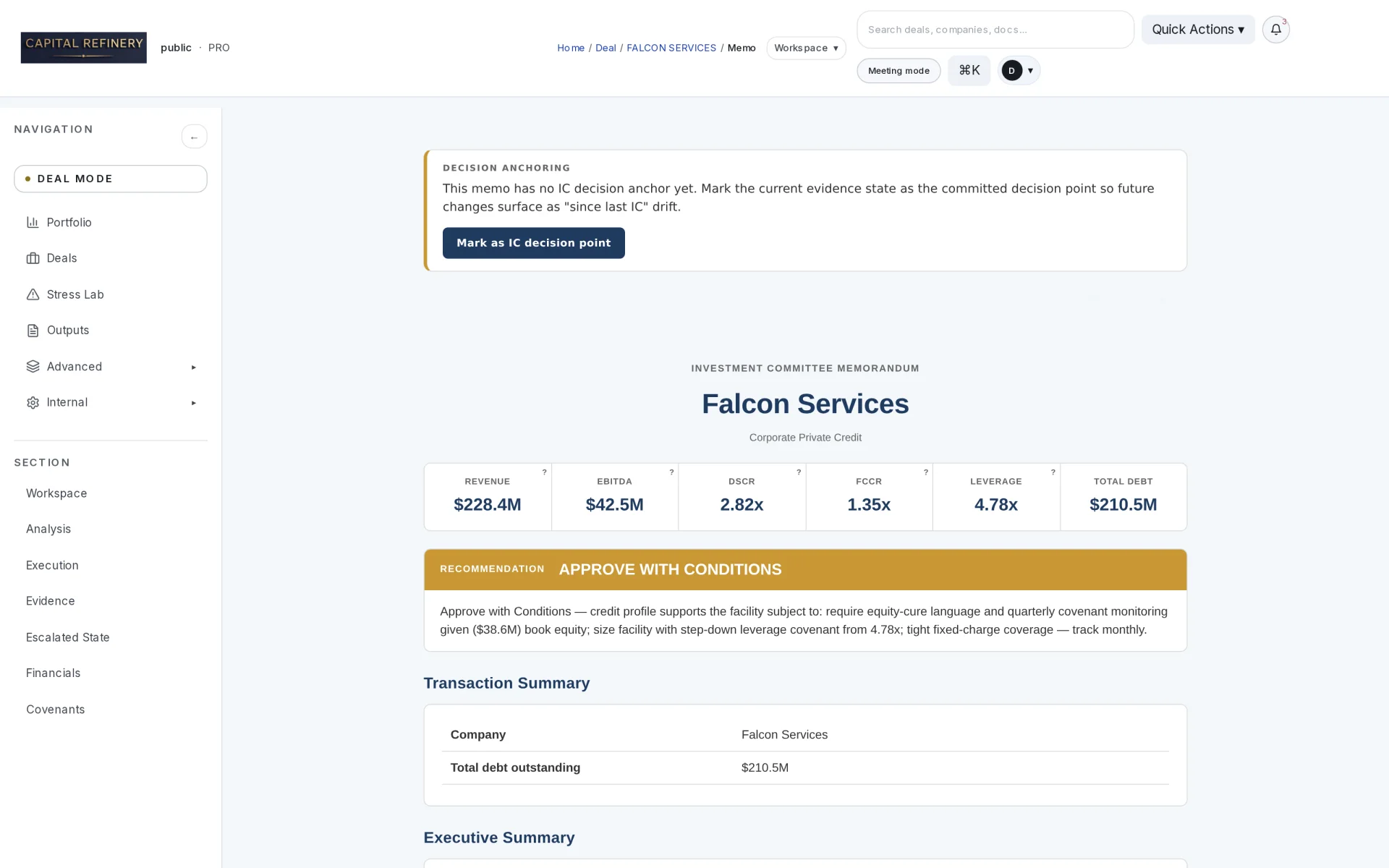
From manual reconstruction to structured rendering
Traditional LP and board reporting is a quarterly reconstruction exercise. Pull updated numbers from spreadsheets, rebuild charts and tables, reconcile inconsistencies between deals and funds, rewrite commentary from scratch. By the time the pack ships, the analyst who knew the position has moved to the next deal.
Capital Refinery replaces that with rendering. The KPIs, scenarios, and risk signals are already structured. Templates map them into LP and board views. Narrative sections draft from the structured insights — partners and IR review and refine, not rewrite.
What goes into an LP pack
- Fund-level performance with attribution
- Position-by-position snapshots with Risk Signals graded against firm policy
- Drift since IC — what changed against the original underwriting and why
- Scenario range: base, downside, stress
- Value creation progress vs the plan submitted at IC
Every figure traces back to source. Every claim has a verifiable fingerprint.
What goes into a board deck
- Position-level Risk Signals scoreboard — observed vs firm threshold, with verdict
- Decision queue — what needs the board's attention this cycle, what is overdue
- Stress Lab output — which scenarios were tested and what they showed
- “Since last board” drift summary — operator updates, thesis triggers, action ownership
- IC anchor history per position — who decided what, when, on what basis
Templates that match firm standards
- LP letters and quarterly reports
- Board packs by company or portfolio
- Fund review books
- IC decision memos and follow-on packs
Templates control which KPIs render, which scenarios surface by default, where commentary sits, and how the firm voice carries through. Refine over time without losing comparability.
The LP-verifiable share page
Signed exports carry an evidence fingerprint; the Continuous IC Memo and the IRA resolve at a public verification URL today. The LP can confirm independently that the numbers in the report are the same numbers that came out of the IC system at the time of approval — not a narrative someone reconstructed two quarters later. Board-pack and LP-letter verification URLs extend the same primitive (in development).
Audit-ready by default
Every figure and statement is:
- Tied back to the source document, candidate cell, and IC anchor
- Associated with the scenario and assumptions in force at the time
- Reproducible from the same data and transformation logic
- Versioned with override audit trail
The supersession dashboard — every signed memo automatically classified as aligned, superseded, or no current anchor the moment a new IC commits — lives at Signed Export Governance →. That's the surface that answers the LP's hardest question: which of our distributed memos still reflects current reality?
Talk to us about your LP DDQ.
Bring us your last LP letter and the governance section of a DDQ template. We'll show you what the equivalent rendered from current IC anchors would look like — every figure source-backed, every export signed, every distributed memo classified against current reality.