The committee debates the call. Not the numbers under it.
Capital Refinery is the IC system of record. The lane-aware memo, the Risk Signals scoreboard, the source-backed numbers, the IC anchor on approval, and the drift tracking after the room votes — so the committee spends its time on judgment, not on reconciling spreadsheets.
Decision queue — what the room actually has to decide.
Constrained options with explicit consequences. Locked decisions reduce the queue. Inaction has a visible cost. Forced resolution, not consensus theater.
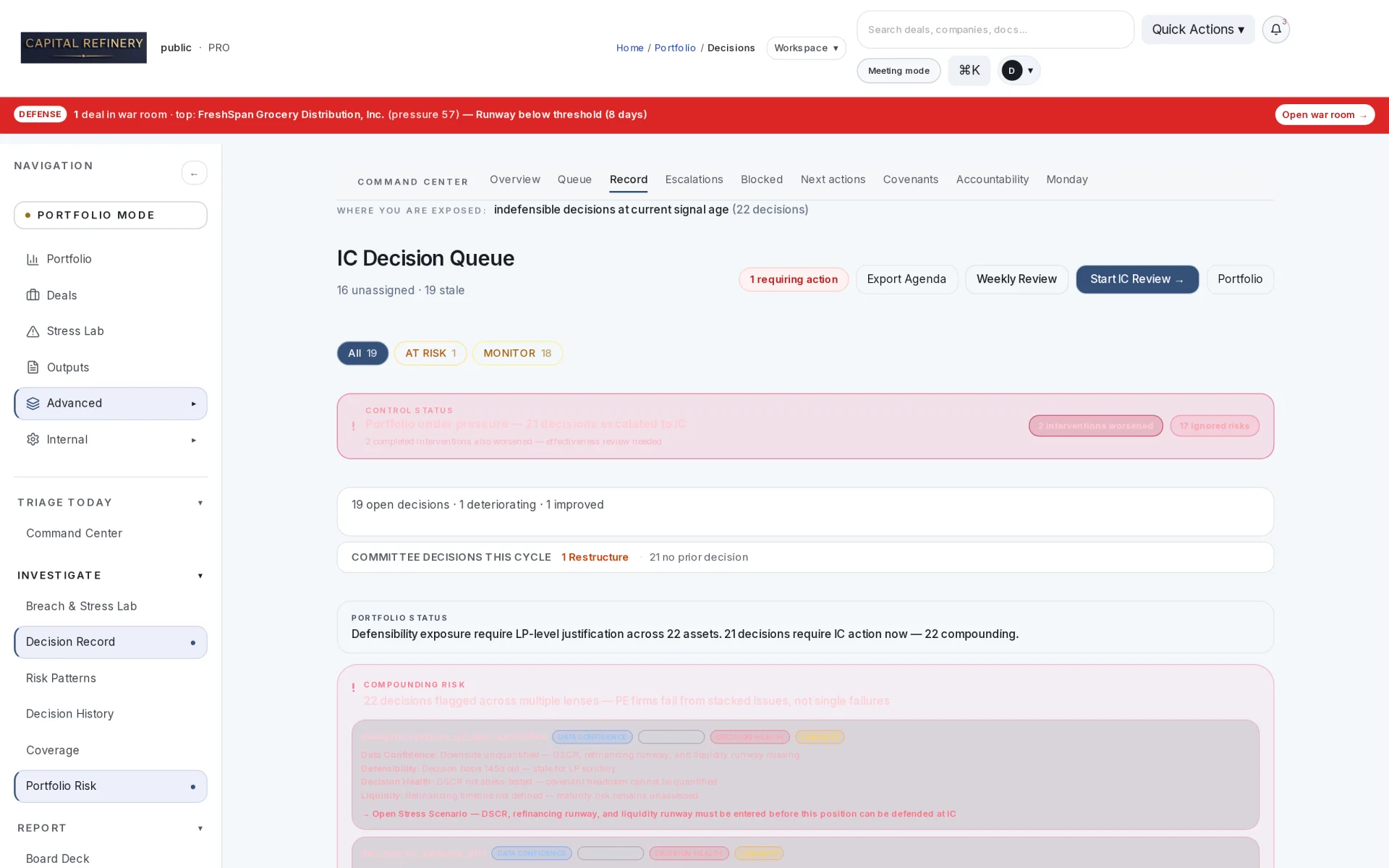
From spreadsheets-on-screens to a structured IC record
Traditional IC prep is a stitched-together package: spreadsheets from the deal team, narratives from the partner, screenshots from the analyst, scenario decks from somebody’s laptop. Definitions drift between artifacts. The committee spends the first half of the meeting reconciling numbers instead of debating the call.
Capital Refinery replaces the package with a structured IC record. One source of truth, one set of definitions, one provenance chain. The team brings judgment to the room. The system brings the numbers.
Every figure tied to source
IC materials produced through Capital Refinery are fully traceable:
- Every financial figure links back to the originating table or rent roll row
- Every KPI links to the firm-standard definition
- Every adjustment and normalization is recorded with override basis
- Every scenario references the exact assumptions in force at the time
This produces a defensible record that survives IC review, LP scrutiny, and external audit.
Risk Signals — observed vs firm policy
The IC memo carries a Risk Signals scoreboard. Observed value, firm threshold, verdict. LTV, expense creep, debt-service runway, cap-strike gap, lease risk, title exceptions, sponsor concentration. Change a firm threshold once and every existing memo re-grades on the next render.
The IC anchor — decision basis locked at approval
The moment the committee votes to approve, conditional-approve, or reject, Capital Refinery writes an IC anchor: a tamper-evident record of the full decision basis at that moment. Every figure, every assumption, every scenario in force, every source document referenced.
From that point forward, every operator update, every covenant test, every thesis trigger is measured against the anchor. “Since IC” becomes the unit of work.
Continuous IC memo — “since last IC”
Between IC cycles, the team can pull the “since IC” view at any time: what changed in the underlying data, which Risk Signals shifted, which thesis triggers tripped, which actions were assigned and resolved. Quarterly review stops being a reconstruction exercise.
Decision Timeline — the full IC history per position
Every position carries a Decision Timeline: every IC anchor, every decision the committee made, every basis it was made on. Operator view shows the full audit metadata. LP view strips PII and shows the decision narrative. Click any anchor to drill into the full snapshot.
What this changes for the room
- Deal teams stop spending Sunday rebuilding the IC pack — the rendering happens from structured data
- Partners walk into the room with consistent materials across deals — same shape every time
- IC meetings shorten because the first 20 minutes of number-reconciliation goes away
- The decision basis is locked on approval — there is no “what did we actually approve” conversation six months later
See your next IC pack render from a real deal.
No demo data. Bring us a CIM, credit agreement, or financial model. Same-day diagnostic pack back — same shape your IC will see, source-backed, graded against firm policy. Or read the full decision lifecycle end-to-end.